
Around 40 percent of land in the U.S is used for agriculture, and it is polluting and killing our
world. With agriculture comes fertilizers, pesticides, and other chemicals that kill weeds and protect the
plants, but pollute our waters. The use of chemicals started around the 1960, leading farmers to spray their
entire fields, spiking up to 11 billion kilograms of nitrogen fertilizer and 300 million kilograms of
pesticides(USGS, 2019). As these fields are loaded with chemicals, once it rains, the chemicals are then
carried and transported into rivers, lakes, and other bodies of water, causing algae blooms and infecting
our drinking water. Harmful algae blooms, HABs, destroy ecosystems, depleting oxygen, killing the
organisms in that body of water, and can block sunlight from reaching deeper organisms in the water(EPA,
2026). Furthermore, if people eat food contaminated by HAB, like seafood, that can lead to many
sicknesses or even death(Home Water, 2026). In order to lessen the impacts of polluted runoff, people have
created smart sprayers. These sprayers originated from Giles et al., a pioneering research team led by Dr.
D.K Giles at the University of California, the idea first emerging in the late 1980s(Durham K, Klassen,
Niederholzer, Downey, 2011). The sprayers use satellites and drones to map out fields and discover which
areas of the field are unhealthy or infected with weeds, classifying weeds and crops based on their
texture, color, and shape features(Blois, 2023))(Kraken Sense, 2024). Splitting the image taken into 4
stripes/sections according to nozzle distance and size. The cameras then detect which sections have weeds
and only spray that specific section. It was shown that 93% of weeds could be sprayed by spraying just
30% of the area using state-of-the-art vision methods to identify weeds(Darbyshire, Salazar-Gomez, Gao,
Sklar, Parsons, 2024). By only spraying certain areas instead of spraying entire fields, pesticides have been
decreased by 2.3 times, one type of smart sprayer, Greeneye Technology, has customers decreasing their
in season herbicides by 88% percent, significantly decreasing the amount of chemicals that are picked up
when it rains or by runoff (Greeneye, 2026).
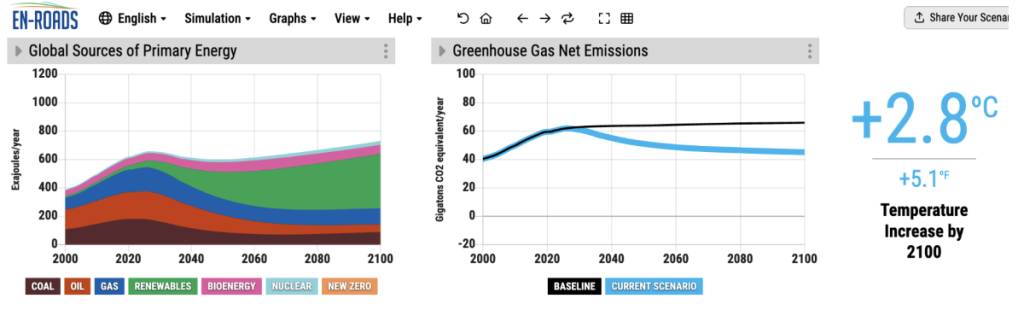
By only using energy to spray certain areas as opposed to whole fields, smart sprayers conserve
energy, emitting less fossil fuels. While smart technology is a good step towards lessening climate change
and bettering the environment by being more energy efficient, real change will only be made once people
severely reduce the amount of fossil fuels they use. On En-Roads, increasing energy efficiency, like the
smart sprayer does, only brings down the future temperature increase by .1 degree celsius (3.3 →3.2 C),
while highly taxing fossil fuels and being energy efficient causes the temperature increase prediction to
drop by .5 degrees (3.3 →2.8 C ), making a big change. In order to make a real change in climate changeand global warming, smart sprayers must also stop using fossil fuels, changing to renewable energies, in addition to using less energy. (En-ROADS, 2026)
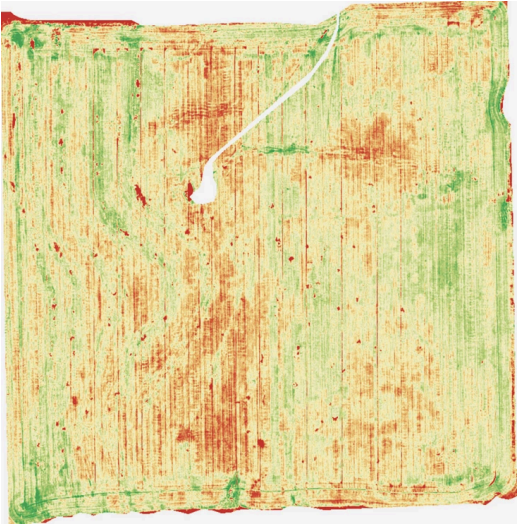
Figure 1: Smart Sprayer Mapping. This rectangular image of green, yellow, and red is what the drones/satellites provide for the farmers and give back to the sprayers. The red/orange areas are the places that need pesticides to help kill weeds, or need chemicals to help the agriculture grow. These maps ensure that the amount of pesticides being sprayed are only hitting the areas and releasing the amounts
needed, not over or under spaying.
Similar, and practically better than smart sprayers, Lawrenceville refrains from and doesn’t use any fertilizers or chemicals on their farms. Lawrenceville’s farm consists of 4 acres of tilled land, 20 acres of pasture, and 3 greenhouses, quite a large farm (Lawrenceville, 2026). Without the presence of fertilizers or chemicals, there is miniscule toxic and polluted runoff that comes off our farm, meaning the chances of water sources around the farm getting polluted and overtaken by algae are very low. Treating the land like a part of their community, Lawrenceville is similar to smart sprayers in how they care for the environment and do everything they can to promote its health. Due to the fact that Lawrenceville doesn’t use pesticides, the smart sprayers wouldn’t be beneficial towards their agriculture, demonstrating how while some technologies can be helpful for the environment, they aren’t necessarily applicable for everyone. Lawrenceville demonstrates how farms and agriculture can be upkept without the use of pesticides and chemicals. If you want to make a change, be more like Lawrenceville.
Although smart sprayers are very beneficial, they come with some consequences and cons. Smart
sprayers are very technologically advanced and creative, but at the same time, very expensive. Modern
sprayers required significant upfront costs, even though long term savings on inputs and labor offset these
expenses. As they are hard to pay upfront, it can lead people into not even starting up smart sprayers as
they can’t pay, preventing the spread of the sprayers and limiting them to the wealthy. In addition, while
less energy is being used for these smart sprayers, they still use a lot of technology creating a complex
network that can be hard to work around(H&R, 2026). Furthermore, the large volume of data collected
from sensors and VRT systems needs effective interpretation through farm management software,
meaning proper training is essential for maximizing benefits(H&R, 2026). This not only takes time but can
lead to the hiring of others, costing money, in order to work and understand such systems. Lastly, these
sprayers take a lot of maintenance and care in order to ensure the prevention of errors in functioning and
chemicals application, further taking up more time(H&R, 2026). While smart sprayers take time and are
costly, they function in order to benefit the world and environment around us, treating our environment
like a part of a community, following the ideals of Leopold’s land Ethics and Utilitarianism. These smart
sprayers might hurt our wallets at first, but ultimately will help and heal our world.
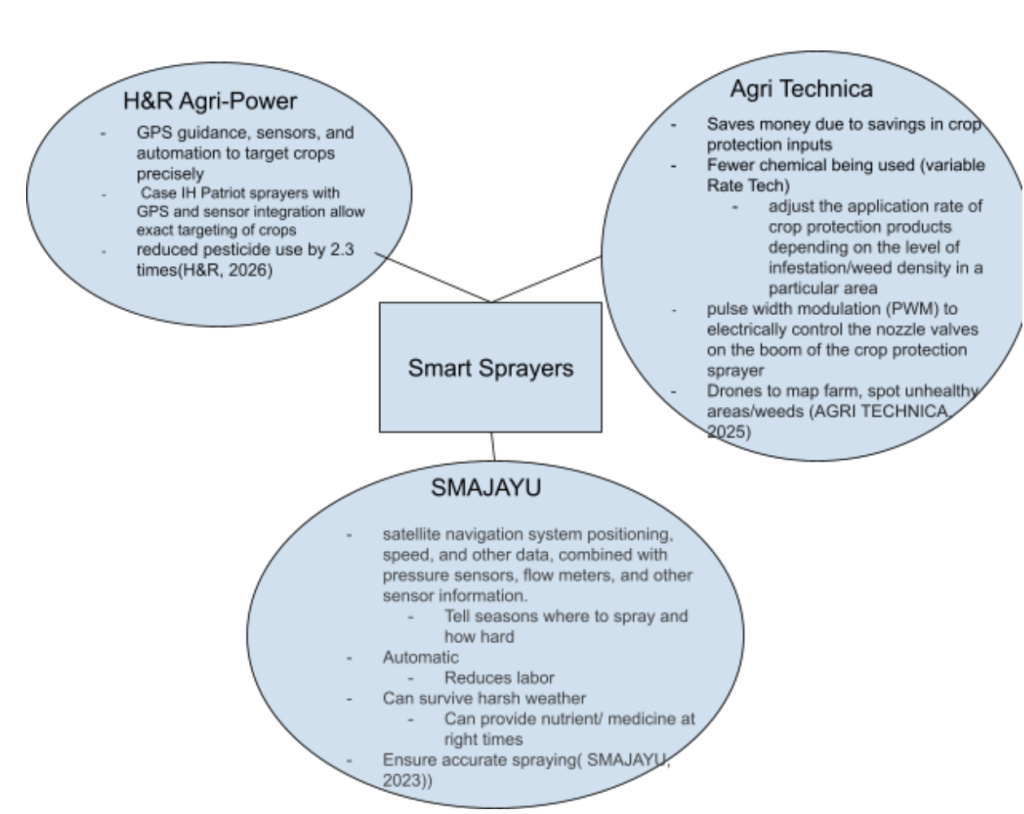
Figure 2: Different Smart Sprayers with Similar Data. Three different types of Smart Sprayers were
searched up to see if all the results were similar. As they get more popular, more smart sprayers are being
created, explaining why there are, in my diagram, 3 different types of sprayers. All three sprayers use
information from drones or satellites to create maps or the specific areas that need sprayers, ensuring
accurate and precise spraying of pesticides. As all three sprayers are very similar, it goes to show that all
smart sprayers have pretty similar results, all which reduce the amounts of chemicals being used and thus
minimizing the amount of polluted runoff and algae blooms that kill and harm environments.
The best part about Smart Sprayers is that they are growing and gaining more awareness, getting
more popular around the world, further decreasing the pesticide and herbicide usage around the world.
Smart sprayers will play a massive impact on making agriculture and food production a safer and
environmentally cleaner process.
References
Agri-Power, H. (2026, February 3). Smart spraying technologies for precision agriculture. H&R Agri-Power. Retrieved February 25, 2026, from
https://www.hragripower.com/blog/smart-spraying-technologies-for-precision-agriculture
Blois, M. (2023, May 7). How technology is helping farmers grow more food with less chemicals. c&en. Retrieved February 25, 2026, from
https://cen.acs.org/food/agriculture/technology-helping-farmers-grow-food/101/i15
Darbyshire, M., Salazar-Gomez, A., Gao, J., Sklar, E., & Parsons, S. (2023, November 3). Towards practical object detection for weed spraying in
precision agriculture. Pub Med. Retrieved February 25, 2026, from https://pubmed.ncbi.nlm.nih.gov/38023838/
Giles, D. K., Klassen, P., Niederholzer, F. J., & Downey, D. (2011). “Smart” sprayer technology provides environmental and economic benefits in
california orchards. eScholarship. Retrieved February 27, 2026, from https://escholarship.org/uc/item/1nv5726c
Lawrenceville. (2026). Sustainability. The Lawrenceville School. Retrieved February 28, 2026, from
https://www.lawrenceville.org/academics/ beyond-the-classroom/sustainability
National Institute of Environmental Health Sciences. (2025, December 22). Algae blooms. National Institute of Environmental Health Sciences.
Retrieved February 25, 2026, from https://www.niehs.nih.gov/health/topics/agents/algal-blooms
The Perfect Water. (2026). Herbicides and pesticides in drinking water: Health risks and how to remove them. The Perfect Water. Retrieved
February 25, 2026, from https://www.theperfectwater.com/faq/herbicides-pesticides-drinking-water-health-risks-removal/?utm_source
Smajayu. (2023, June 12). Increasing crop yields using smart agriculture spraying systems. Smajayu. Retrieved February 25, 2026, from
https://www.smajayu.com/smart-agriculture-spraying-system/?srsltid=AfmBOoqEXl1brmHZJmHXXs8RzuUmUgbgOZj8Ja8Q15BuZ
29HzJzBxScS
Tech, A. (2025, November 14). Smart spraying. Agri Technica. Retrieved February 25, 2026, from
https://www.agritechnica.com/en/news/smart-spraying
United States Environmental Protection Agency. (2025, April 11). [The effects: Human and animal health]. United States Environmental
Protection Agency. Retrieved February 25, 2026, from
https://www.epa.gov/nutrientpollution/effects-human-and-animal-health?utm_source
United States Environmental Protection Agency. (2025, August 1). Non point source: Agriculture. United States Environmental Protection
Agency. Retrieved February 25, 2026, from https://www.epa.gov/nps/nonpoint-source-agriculture?utm_source
United States Environmental Protections Agency (Ed.). (2025, March 20). Sources and solutions: Agriculture. United States Environmental
Protections Agency. Retrieved February 25, 2026, from
google.com/url?q=https://www.epa.gov/nutrientpollution/sources-and-solutions-agriculture?utm_source%3Dchatgpt.com&sa=D&sour
ce=docs&ust=1772035583536583&usg=AOvVaw1J9m7RTd2SecEEwTwI01i6
Water Missions Area. (2019, march 1). Agricultural contaminants. USGS. Retrieved February 25, 2026, from
https://www.usgs.gov/mission-areas/water-resources/science/agricultural-contaminants?utm_source