
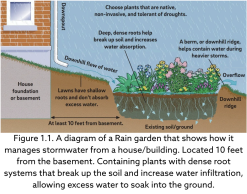
Rain gardens are a nature-based climate solution that improves water quality and manages stormwater runoff. A shallow depression planted with plants and grasses, designed to capture runoff from roofs, roads, and parking lots, allows water to slowly infiltrate into the soil rather than flow directly into storm drains
(Ground Water Foundation, 2026). It acts like a sponge, as the runoff passes through soil and plant roots, and sediments, fertilizers, and other pollutants are filtered out before reaching nearby bodies of water. They are particularly important as climate change increases the frequency and intensity of storms, which in some cases can overflow urban drainage systems and lead to flooding (Carter, 2024). By decreasing the speed of runoff and increasing infiltration, rain gardens reduce erosion and decrease flooding. Plants are used in rain gardens to absorb moisture. By improving water quality, rain hardens as it helps by increasing vegetation and evapotranspiration (EPA, United States Enviromental Protection Agency, 2026). Relying on processes rather than an engineered practice, rain gardens are considered relatively cheap in comparison to invasive technology. Resulting in rain gardens being promoted in cities, campuses, and suburban towns for a sustainable approach to stormwater pollution.
Lawrenceville contains many different surfaces that produce runoff, such as rooftops, sidewalks, roads, and parking lots. Many of which enter through drainage systems, where water moves quickly without filtering pollutants. Implementing rain gardens would complement the sustainable practices done by the school. Lawrenceville is already big on sustainability, through student leadership, composting meals, solar panels, and a lot more (The Villeage Green, 2025). Rain gardens would be a great addition to the school’s sustainability. In addition, they could be taught in Environmental science. By doing so, rain gardens could be installed near dorms, buildings, and parking lots since those are the areas that produce most of their runoff. Rain gardens provide environmental benefits, improving water quality by filtering pollutants before they reach rivers and streams, protecting the ecosystem and wildlife, providing drinking water, and reducing flooding significantly (Leblanc, 2021).
Although they are a great source for the short term, there is not enough afforestation on its own to have a strong enough impact on our climate future. They produce a reduction of CO2, planted through vegetation, in which grass and flowers absorb CO2 due to photosynthesis. The carbon is stored in the plants’ biomass and soil organic matter, acting as carbon sinks. In addition, the stormwater runoff that is caught in Rain gardens carries nutrients such as nitrogen, potassium, and algal blooms, contributing to a process where greenhouse gases are released, including CO2. Rain gardens allow the nutrients to filter, further reducingg the risk of emissions (Science Direct, 2026).
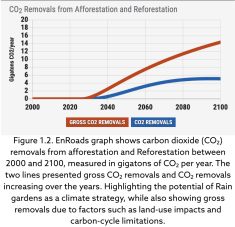
Afforestation means planting trees and plants in areas where they lack forest cover, increasing CO2
absorption and long-term carbon storage. For example, figure 1.2 displays an En-Roads graph that is used to demonstrate the amount of CO2 removed. We can put afforestation at 100%, which is highly unlikely because that would mean we would only focus on this model. We see the decrease in CO2 is pretty significant; however, the temperature change to 2100 is only 3.2 degrees celsius in comparison to the prediction if we do
not use rain gardens or other tools, which is 3.3 degrees celsius. This is because there is not enough afforestation on its own to have a strong impact; we still would need more technology to occur in order to help our climate future. In addition to the setbacks, Rain gardens have installation costs, which would include soil preparation and specific plant selections. They also have maintenance requirements, which could be harder with communities that do not have the resources.
Through ethical frameworks, Rain gardens are mostly connected to leopold land ethic, which further argues that human members of an ecological community have moral responsibilities to protect within the community. Doing so, they strongly reflect by treating land and water as living systems rather than drainage problems, using the runoff to help infiltrate soil. They use plants to support biodiversity, as performing photosynthesis. As well as reducing human harm to waterways and aquatic life. Although Rain gardens are not seen as a permanent and long-term solution to our climate, they can play a meaningful role in environmental challenges, working well with other solutions. By capturing stormwater runoff, filtering pollutants, and contributing to carbon storage, the benefits are extended. With its connection to Leopold, its natural process can further strengthen environmental solutions and foster relationships between humans and land.
Bibliography
US EPA. (2018, December 27). Soak Up the Rain: Rain Gardens. US EPA. https://www.epa.gov/soakuptherain/soak-rain-rain-gardens
Groundwater Foundation. (2022). All about rain gardens. The Groundwater
Foundation. https://groundwater.org/rain-gardens/
Leblanc, L. (2021, November 2). Coalition for the Delaware River Watershed —
How Rain Gardens Can Help Save the Environment. Coalition for the Delaware River
Watershed. https://www.delriverwatershed.org/news/2021/11/1/how-rain-gardens-can-help-save-the-environment
Dudrick, R., Hoffman, M., Antoine, J., Austin, K., Bedoya, L., Clark, S., Dean, H., Medina, A., & Gotsch, S. G. (2024). Do plants matter?: Determining what drives variation in urban rain garden performance. Ecological Engineering, 201, 107208–107208. https://doi.org/10.1016/j.ecoleng.2024.107208
Peng, Y., Wang, Y., Chen, H., Wang, L., Luo, B., Tong, H., Zou, Y., Lei, Z., & Chen, S. (2024). Carbon reduction potential of a rain garden: A cradle-to-grave life cycle carbon footprint assessment. Journal of Cleaner Production, 434, 139806. https://doi.org/10.1016/j.jclepro.2023.139806
Green Infrastructure – Sustainable Princeton. (2025, October 9). Sustainable
Princeton. https://www.sustainableprinceton.org/resources/residents/your-yard/green-infrastructure/
Rain Gardens. (n.d.). Jersey-Friendly Yards. https://www.jerseyyards.org/create-a-jersey-friendly-yard/rain-gardens/Carter, K. (2024, May 16). How rain gardens can help prevent stormwater runoff.
Cbsnews.com; CBS Detroit. https://www.cbsnews.com/detroit/news/science-of-weather-rain-gardens/
The VILLEage Green – The VILLEage Green is a student-run newsletter published by an editorial team representing the Sustainability Council of The Lawrenceville School. (2025, December 10). Lawrenceville.org.
https://sustainability.lawrenceville.org/
Philadelphia Water Department. (n.d.). Rain Gardens – Green Stormwater
Infrastructure. Water.phila.gov. https://water.phila.gov/gsi/tools/rain-garden/