
Introduction:
Climate change is one of the most urgent challenges of our time, and buildings contribute a significant portion of global carbon emissions, largely from heating and cooling systems powered by fossil fuels. In colder climates like New Jersey, natural gas and oil heating systems add heavily to greenhouse gas emissions, making schools key targets for climate action. Ground-source heat pumps (GSHPs), or geo-exchange systems, transfer heat to and from the earth to provide both heating and cooling with far greater efficiency than traditional systems. Lawrenceville has implemented these systems in several LEED-certified buildings, including Tsai Field House and Tsai Commons, recapturing over “90%” of the steam used for heating (Lawrenceville School Sustainability Page). Switching from natural gas heating to ground‑source heat pumps in school buildings significantly cuts carbon emissions, is already relevant at Lawrenceville, and provides broader climate and social benefits.
Background (How GSHPs Work):
GSHPs are among the most “energy-efficient and environmentally sustainable” systems because they use the Earth’s constant underground temperature to transfer heat (Comparative Life Cycle Assessment, 2022). Unlike air-source heat pumps (ASHPs), which rely on fluctuating outdoor air temperatures, GSHPs rely on geothermal energy from the ground, where temperatures remain stable year-round. While GSHPs have higher impacts “during manufacturing and installation” due to drilling and materials, they perform better during operation and have lower long-term environmental impacts overall (Comparative Life Cycle Assessment, 2022). The study also notes that the “geothermal probe circuit can last up to 100 years, which allows for multiple operational life cycles of the geothermal plant” (Comparative Life Cycle Assessment, 2022). For schools, this means upfront environmental and financial costs are caused by long-term reductions in emissions and energy use, emphasizing the importance of evaluating sustainability over the full life cycle.
GSHPs and Emissions Reductions:
GSHPs reduce emissions significantly compared to natural gas systems. One US study reports that “emission reductions for a heat pump over furnace [are] 38–53% for carbon dioxide, 53–67% for 20-Year global warming potential (GWP), and 44–60% for 100-Year GWP” (Greenhouse Gas Emission Forecasts, 2022). The study also adds that the furnace’s “impact of fugitive emissions is significantly higher than that of the heat pump” (Greenhouse Gas Emission Forecasts). Methane leaks from gas systems drive short-term warming, so electrifying heating with GSHPS addresses both immediate and long-term climate risks. A commercial building study also found that adopting GSHPs could reduce energy use intensity by “approximately 29%” and carbon dioxide emissions by “25%,” depending on building type and climate (Adopting Ground Source Heat Pumps, 2025). For educational institutions like Lawrenceville, this versatility means the technology can be applied to older and newer buildings alike, maximizing emissions reductions across campus infrastructure.
Relevance to Lawrenceville:
Lawrenceville’s sustainability initiatives show GSHP technology in practice: “Tsai Commons, Tsai Field House, and their surrounding parking area include green features like geoexchange heating and cooling, waste heat recapture, permeable pavement, rain gardens, and bioswales” (Lawrenceville School). Additionally, the campus “recaptures more than 90% of the steam used to heat campus buildings” (Lawrenceville School Sustainability Page). These examples show that GSHPs are not only technologically effective but also achievable in real-world educational settings. Combined with other energy-saving measures, Lawrenceville’s approach provides a replicable model for other institutions seeking to reduce building emissions.
Global Implications and Scaling:
Globally, heat pumps are expanding rapidly: “Around 10% of space heating needs globally were met by heat pumps in 2021, but the pace of installation is growing rapidly” (IEA, 2023). Also, the IEA estimates that heat pumps “have the potential to reduce global carbon dioxide (CO2) emissions by at least 500 million tonnes in 2030” (IEA, 2023). If the world scaled GSHP adoption similarly to Lawrenceville’s approach, the cumulative impact would be massive. However, challenges remain. The IEA warns that “government policy support is needed” to assist consumers in overcoming “heat pumps’ higher upfront costs relative to alternatives.” (IEA, 2023). Reuters similarly notes: “Residents don’t have any upfront costs for the pumps and benefit from lower heating bills and associated emissions” (Reuters, 2025), while CalMatters adds that “Unless folks are saving money on the operating cost, it doesn’t pencil out” (Cristopher & Lazo, 2026). These findings illustrate that while GSHPs are effective, maximizing their impact requires supportive policies and energy-efficient building design.
En-Roads Modeling/Graph:
Using MIT’s En-ROADS climate stimulator, baseline warming is projected to be +3.3 degrees Celsius of global warming by 2100 (En-ROADS, 2026). After increasing building electrification and energy efficiency, projected warming decreases to approximately +3.1°C. Although this 0.2°C reduction may appear small, it demonstrates that building-sector actions, like GSHPs, can have measurable global climate impacts. Figure 1 shows how electrifying heating systems in LEED-certified buildings, such as Tsai Field House, contributes to emissions reductions. These improvements also reflect broader social and ethical benefits, aligning with the Humans, Ethics, and Environment frameworks, including utilitarianism, economic considerations, and Leopold’s Land Ethic, because they reduce harm, save resources, and promote responsible stewardship of the environment.
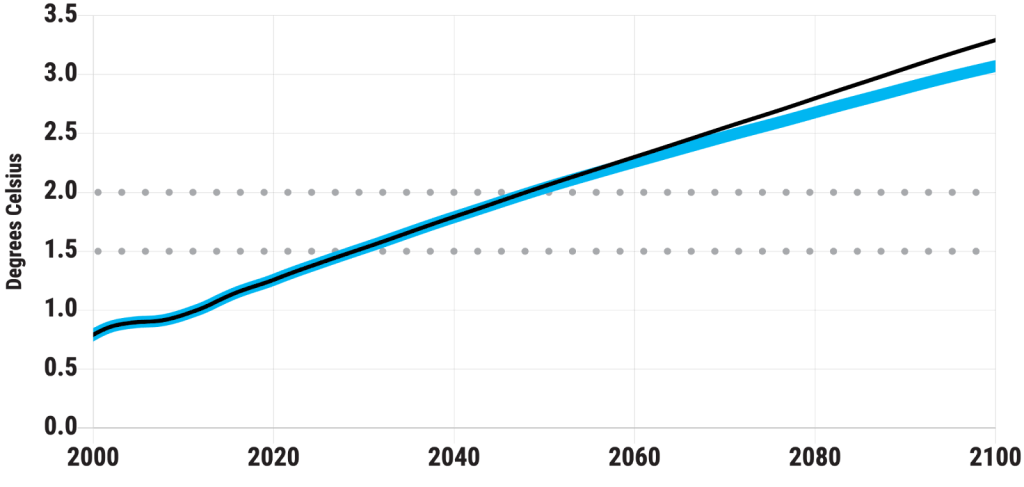
Figure 1: Projected global temperature rise under baseline conditions (3.3°C) compared to increased building electrification and energy efficiency (3.1°C), modeled using the En-ROADS Climate Simulator (2026).
Department of Energy Visual: Heat Pump Adoption Potential
The U.S. Department of Energy explains that geothermal heat pumps use the ground as “a heat sink” in summer and “a heat source during the winter” while also not relying on the “temperature of the outside air” (U.S. Department of Energy, n.d.). Figure 2 demonstrates how GSHPs function year-round, using stable underground temperatures to reduce energy emissions while providing consistent heating and cooling. For institutions like Lawrenceville, this efficiency translates into long-term operational savings and reliable energy performance.
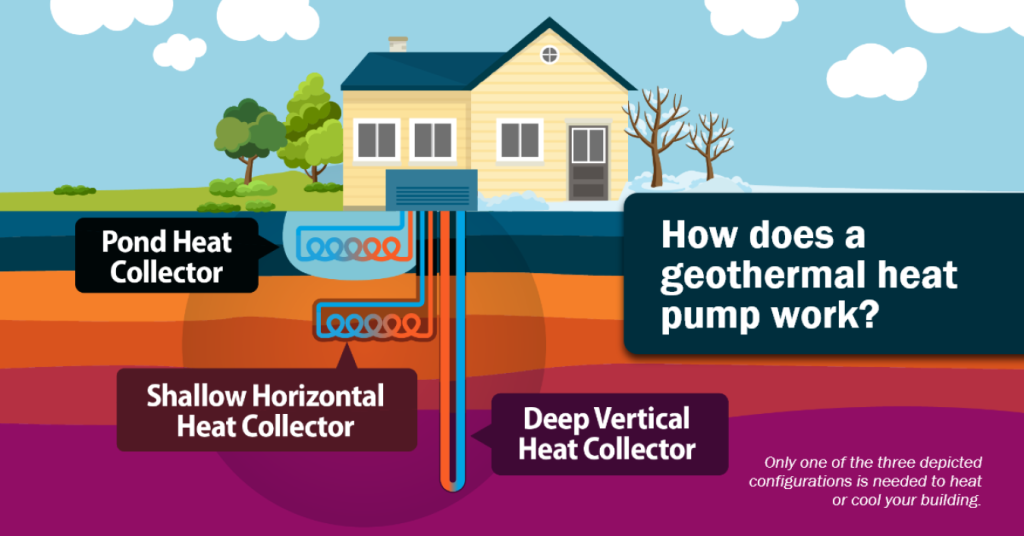
Figure 2: Diagram illustrating how geothermal heat pumps use stable underground temperatures as a heat source in winter and a heat sink in summer (U.S. Department of Energy, n.d)
Conclusion:
Ground-source heat pumps significantly reduce lifecycle carbon emissions compared to natural gas. Lawrenceville’s implementation demonstrates its real-world potential, and EnROADS modeling suggests that building electrification and energy efficiency can reduce projected warming from +3.3°C to +3.1°C. While GSHPs alone cannot solve climate change, they are a meaningful component of broader decarbonization strategies, offering environmental, financial, and ethical benefits.
Works Cited
- Energy Information Administration. (2023). The future of heat pumps. International Energy Agency. https://www.iea.org/reports/the-future-of-heat-pumps
- En-ROADS climate solutions simulator. (2026). Climate Interactive, Massachusetts Institute of Technology Sloan School of Management, & Ventana Systems [Computer simulation]. https://www.en-roads.org
- CalMatters. (2026, February). Heat pumps could increase electricity demand in California. https://calmatters.org/environment/2026/02/heat-pumps-ca-electricity
- Reuters. (2025, November 24). Heat transition: Inside the race to break free from fossil fuels in buildings. https://www.reuters.com/sustainability/climate-energy/heat-transition-inside-race-break-free-fossil-fuels-buildings–ecmii-2025-11-24
- U.S. Department of Energy. (n.d.). Geothermal heat pumps. Energy Saver. https://www.energy.gov/energysaver/geothermal-heat-pumps
- Lawrenceville School. (n.d.). Sustainability page. lawrenceville.org/academics/beyond-the-classroom/sustainability
- Adopting Ground Source Heat Pumps in Commercial Buildings: Nationwide Analysis of Energy Savings and Decarbonization Potentials. (2025). Building and Environment. https://www.sciencedirect.com/science/article/pii/S0196890425011598
- Comparative Life Cycle Assessment of the Ground Source Heat Pump vs. Air Source Heat Pump. (2022). Renewable Energy. https://www.sciencedirect.com/science/article/pii/S0960148122002233
- Greenhouse Gas Emission Forecasts for Electrification of Space Heating in Residential Homes in the US. (2022). Energy Policy. https://www.sciencedirect.com/science/article/pii/S0301421522000386