
When you look at airplanes flying in the sky with the white clouds trailing behind them,
they are actively hurting the environment. The emissions from aviation travel are the cause of
3.5% of climate change (NOAA, 2020). Carbon Dioxide is a main source of climate change and
is well known to be emitted from aviation, but it is not the only source. Other emissions are
water vapor, soot, nitrogen oxides, and sulfate aerosols. Contrails are those white streaks in the
sky emerging from the airplanes. They are made up of water vapor, soot, and aerosols (Seeling et
al., 2025). These contrails trap heat, which contributes directly to global warming. Sustainable
Air Fuel (SAF) is a green fuel that was invented to reduce the harmful emissions from airplanes
and slow down climate change. If used regularly, SAF can reduce CO2 emissions by at least 27%
to 87%, which is very significant (Watson et al., 2024).
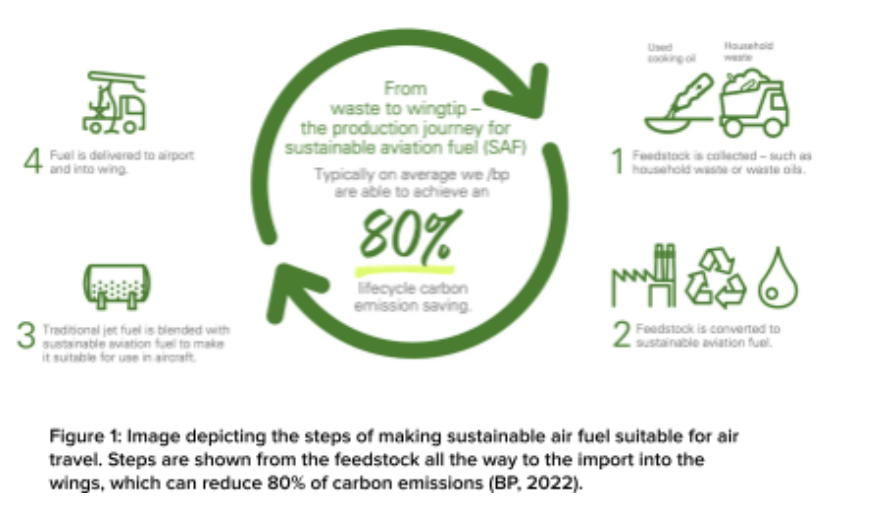
Sustainable air fuel is made up of renewable carbon sources like plant oils, woody biomass, and other feedstocks. It can be used in pre-existing aircrafts, without any change or additional costs to modify the engines. Regular aviation fuel, usually a type of kerosene, is made from the traditional oil that’s stored underground (Zahid et al., 2024). When used and burned, many greenhouse gases are produced and released into the atmosphere. Even though SAF still releases some carbon dioxide, it emits far fewer harmful emissions and is made from renewable and waste materials (Zahid et al., 2024). As depicted in Figure 1, starting from feedstocks, the switch to SAF can reduce up to 80% of carbon emissions, compared to the use of fossil fuels.
This fuel is very beneficial for the environment in more ways than just carbon emissions. While the benefit of 80% of carbon emissions being reduced is very exceptional, many other emissions are reduced as well. For example, there is a reduction in the sulfur oxides (The US Department of Energy). These cause respiratory problems and also acid rain, which is highly harmful to the environment. Additionally, there are fewer fine particles, which contribute to poor air quality, especially around airports. Methane emissions from landfills are also reduced, as waste materials are instead used to make the fuel, rather than sit in landfills (The US Department of Energy).
Sustainable air fuel is relevant to the Lawrenceville community. Many students rely on
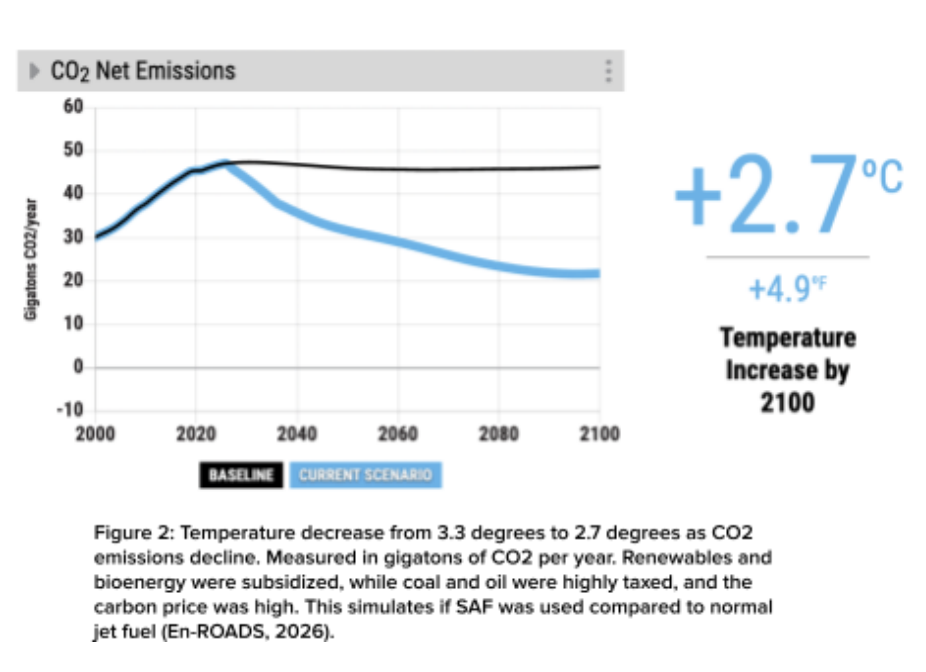
air travel, as 16% of students are international and also 70% boarding students. With 800 students, a good majority have to fly to arrive on campus, and many air trips are needed throughout the year, both domestic and international. For example, a one-way flight from Newark to Seoul, Korea, as a couple of students use it, emits around 2.4 metric tons of CO2 per passenger (MyClimate, 2026). Domestic flights, for example, Newark to Los Angeles, around 0.7 metric tons are released on a one-way flight per passenger (MyClimate, 2026). With the number of flights needed to travel to and from Lawrenceville multiple times a year, the amount of carbon emissions is very high, and the carbon footprint at Lawrenceville increases because of it. While Lawrenceville as an institution cannot do anything about it, if SAF starts to be implemented in flights, the carbon footprint would decline a lot. If any airports located near the school start to use it, students could choose to fly on those flights, decreasing carbon emissions. As seen in Figure 2, the baseline carbon emissions are very high, but when SAF is simulated with an increase in bioenergy and a decrease in other resources, the emissions drop a high amount, and Lawrenceville students’ carbon footprint would decline, helping prevent global warming.
Even though sustainable air fuel offers the possibility of cleaner travel and protecting the
planet, there are some challenges involved. The major challenge is the cost of SAF. While there
do not have to be any adjustments to aircraft to use the fuel, the fuel is more expensive and could
cost 3-5 times more than regular fuel (Hepher et al., 2025). SAF costs between $4 and $ 10 per
gallon, while regular jet fuel costs only $2 to $ 3 per gallon (Global Renewable Sustainable
Aviation Fuel, 2025). Gallons needed for each aircraft are different, but for example, a Boeing
474 travelling ten hours could burn 36,000 gallons (Hepher et al., 2025). Now, with regular fuel,
it would only cost $72,000-108,000, but with SAF, it would cost $144,000-360,000. This would
cause higher operating costs, which could then lead to a price increase in tickets. This would be
unfair to less wealthy people if the prices get more expensive than they already are. SAF is also
made from agricultural feedstocks, using lots of land and water. This could cause competition
with all three of those resources. From the Utilitarian viewpoint, SAF gives the greatest amount
of good to the greatest number of people. Climate change affects millions of people, and slowing
that process down can protect the Earth and the humans, plants, and animals living on it.
Air travel is a factor expediting climate change, and sustainable air fuel can help combat
that. Implementing SAF could reduce greenhouse emissions by 80% without having to modify
planes. While SAF cannot completely prevent climate change, it could help slow it down. Other
technologies and approaches are needed for a big impact on the environment, but SAF could still
be the start.
Works Cited
Plucinska, J., & Hepher, T. (2025, October 13). Airlines face price-gouging by green jet fuel sellers,
IATA says. Reuters.
Stiftung myclimate. (2026). myclimate. Myclimate.org.
https://co2.myclimate.org/en/portfolios?calculation_id=8485707
US Department of Energy. (2022). Sustainable Aviation Fuels. Office of Energy Efficiency &
Renewable Energy. https://www.energy.gov/eere/bioenergy/sustainable-aviation-fuels
Zahid, I., Muhammad Hamza Nazir, Chiang, K., Christo, F., & Ameen, M. (2024). Current outlook
on sustainable feedstocks and processes for sustainable aviation fuel production. Current
Opinion in Green and Sustainable Chemistry, 49, 100959–100959.
https://doi.org/10.1016/j.cogsc.2024.100959
Watson, M. J., Machado, P., da Silva, A. V., Rivera, Y., Ribeiro, C., Nascimento, C., & Dowling, A. W.
(2024). Sustainable aviation fuel technologies, costs, emissions, policies, and markets: A critical
review. Journal of Cleaner Production, 449(1). https://doi.org/10.1016/j.jclepro.2024.141472
Seelig, T., Wolf, K., Bellouin, N., & Tesche, M. (2025). Quantification of the radiative forcing of
contrails embedded in cirrus clouds. Nature Communications, 16(1).
https://doi.org/10.1038/s41467-025-66231-8
Kiest, K. (2020, September 3). Aviation is responsible for 3.5 percent of climate change, study
finds – NOAA Research. NOAA Research.
https://research.noaa.gov/aviation-is-responsible-for-35-percent-of-climate-change-study-finds/
En-ROADS Climate Scenario. (2026). Climateinteractive.org.
https://en-roads.climateinteractive.org/scenario.html?v=26.2.0&p1=28&p7=22&p16=-0.03&p23
=-19&p39=146&p235=1.6
Moyes, A. (2022, July). What is sustainable aviation fuel (SAF) and why is it important? | News
and views. Air Bp.
admin. (2025, February 9). Global Renewable Sustainable Aviation Fuel (SAF) Market Size, Share
& Trends Analysis 2026-2032. PW Consulting Chemical & Energy Research Center.
https://pmarketresearch.com/chemi/renewable-sustainable-aviation-fuel-saf-market