
As global temperatures rise and our world dives deeper into the chasm that is climate
change’s lasting impacts on the earth, there are still measures being taken to slow down the
effects. One major source of greenhouse-gas emissions is from the use of gasoline automobiles.
Although this is not the only thing emitting pollutants into the atmosphere, it is one of the most
widely used technologies doing so. However, the creation of electric vehicles has been
positioned in clear opposition to gas-powered vehicles. As energy efficient and electric
technology becomes more prevalent in the modern world, the real question is, “Can electric cars
make the impact the earth needs?”
The main difference between EVs and gas-powered vehicles is its internal power source.
According to c3controls, a company that sells car parts, but also provides information about
them, explains, “an electric vehicle battery (EVB) is the standard designation for batteries used
to power electric motors of all types of EVs”; Also, they use “rechargeable lithium-ion batteries”
(Understanding the design & manufacture of Electric Vehicles). Gas-powered vehicles use “a
spark-ignited internal combustion engine” (2019). EVs and gas-powered vehicles can run on
either electricity or gas respectively until they need to be recharged/refilled.
Gas-powered vehicles have been the most common type of car for decades, but now
electric cars are slowly being integrated into society. Lawrence Township and townships across
New Jersey are adopting policies that support the use of electric cars. The Municipal Engineer of
Lawrence Township, James F. Parvesse, states in an Ordinance document, “The Township of
Lawrence encourages greater ownership and use of electric vehicles.” (Nerwinski, 2022). They
are acting on this statement by creating installations such as, for every 55-99 parking spaces
there must be 1 EV space and for every 100+ parking spaces there must be 2 and +1 every 100
more spaces (Nerwinski, 2022). The “Total Number of Charging Stations [public is]: 17” in
Lawrence Township (Lawrence Township, New Jersey EV Charging Stations Info). This is also
happening on the Lawrenceville campus with there being three EV parking/charging stations
already. Lawrence is making it easier for residents to travel/live with an electric car, a practice
that encourages the buying and usage of EVs as a whole.
On a global scale, EVs are dominating the car industry in countries around the world. The
main example of this is Norway. The World Resources Institute states, “In Norway, 9 out of 10
new cars are electric” (Jaeger, 2023). By enforcement of the Norwegian government in 2019, “In
addition to various tax exemptions, zero-emission vehicles in Norway enjoy discounts on
parking, tolls and car ferry fares” (2019). The reasons to buy EVs were likeable. However, the
benefits given, drew too many people to buy EVs. Now, “Norway’s government has gradually
rolled back incentives for luxury EVs and some of the other perks for electric vehicle owners.”
(Jaeger, 2023). Things like “bus lane access and free parking” are being revoked since EVs are
not a minority of cars on the road now (Jaeger, 2023). Joel Jaeger interestingly assumes that
“Some of these policies may encourage people to choose car travel over public transit, which
would increase emissions” (Jaeger, 2023).
Using EnRoads, I simulated the possible scenario under transportation to further
understand what Jaeger was talking about: highly increased energy efficiency and highly
subsidized electrification. If electric transport subsidy and charging infrastructure is highly
subsidized and 50% of the purchase cost, this initially helps reduce the percent existing transport
by carrier of fuel. It also shows an increase in electric for about 40 years. However, around 2074
the trendline returned to normal. Also in this scenario, the global temperature increase by 2100
only goes down by 0.1%.
This scenario corresponds with what Norway is experiencing, simply at a slower pace.
Norway had an “increase [in] adoption of electric cars” and it initially helped lower percentages
of fuel and increase in electricity, but it will eventually return to normal (2026). This is because
when Norway reduces its liberties given to EV users, the balance between gas-powered and
electric cars will even back out.
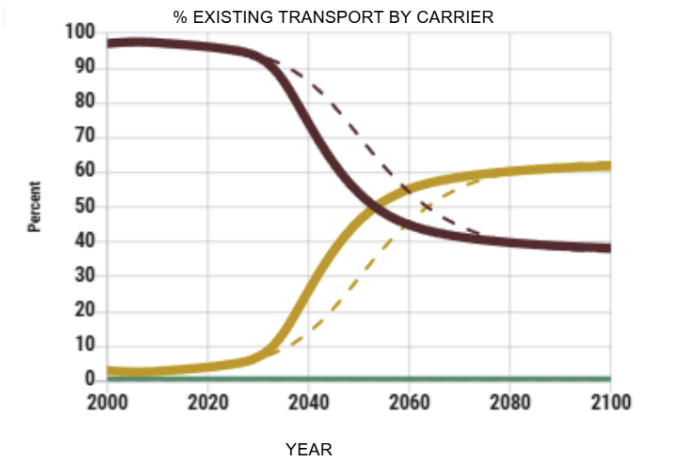
Figure Description: Fuel is shown in maroon and electric is shown in yellow. The dotted
lines show the natural trend while the solid lines show the simulated trends. The two line types
converge around 2074.
So, even though EVs are being advertised as energy efficient, are their mass
production/usage really able to have positive impacts on global temperature rises? This is
complicated. In Norway’s situation, the answer is proving to be no. There is a lot of data
suggesting EVs are a better alternative to gas-powered cars, but there are still problems that do
not entirely help the emission-reduction issue. According to Mike Lee, “New research says
building electric vehicles leaves a bigger carbon footprint than making gas-powered cars, though
EVs make up the difference in the long run” (Lee, 2024). The creation of EVs doesn’t mean that
there are no gas emissions. Fossil fuels are the source of the electricity in EV’s charging ports
(Ezeoha, 2020). Additionally, creating the lithium-ion batteries and mining the materials needed,
still releases harmful gases (Lee, 2024). Mining for lithium in the U.S has also caused many
human rights violations. For example, recently, “The US government’s decision to permit
Lithium Americas to mine at Thacker Pass in Nevada violated Indigenous people’s right by not
obtaining free, prior, and informed consent.” (2025). Additionally, mining also causes land
degradation which is further harming the environment.
Even though there are issues with EVs, I realized that the Gen Z generation must have an
idea of what kind of cars they want to buy. I conducted a study of Lawrenceville students’
desirability to buy electric cars. The question below was prompted then the participants were
asked to explain their answer choice.
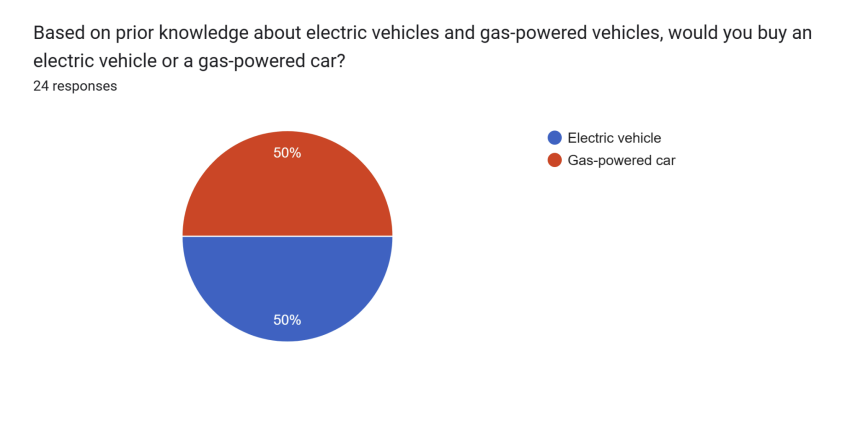
Figure Description: Out of 24 students, 12 would rather buy gas-powered cars and 12
would rather buy electric vehicles. Gas-powered users all said something similar to “I would buy
a gas-powered vehicle because it is more reliable” and “they are less expensive”. EV users
explained their choice with something like “I chose electric because it is portrayed to not
contaminate as much”.
According to students who would rather buy gas-powered vehicles, the common
consensus is that they are inconvenient. The agreement among EV users is that the
environmental outcomes are the key factor in deciding on an EV.
From students’ responses, one can see that the issues of EV accessibility are clear. Only a
select group can really afford electric cars (in the U.S.). American Experiment explains,
“According to data from the Energy Information Administration, 67 percent of households that
own an electric vehicle make more than $100,000 per year.” (Orr, 2018). Another group of
people who have trouble with accessibility to EVs is wheelchair users (Anonymous, 2024).
However, there are policies in other countries that are trying to find solutions to this problem.
ProQuest explains, “To address the needs of wheelchair accessible vehicle (WAV) users in the
U.K.s transition to electric,….eVITA. It’s an accessible and versatile concept electric wheelchair
accessible vehicle (eWAV)”(Anonymous, 2024). My study goes in accordance with what Science
Direct believes “that if a flexible demand is available within the electricity market then the usage
of pumped storage, and to a lesser extent Open Cycle Gas Turbines are reduced.” (Calnan, 2013).
If prices are more affordable and there is more widespread accessibility to EVs, the amount of
gas emissions from transportation can be reduced.
EVs are being developed all around the world, close to home and far away. However,
there are still complications with this technology, but their impact on society could be huge. But
the outcome of this depends on future buyers worldwide.
Acknowledgements:
Peer Reviewed by Rania Yakubu
Citations generated in part by mybib.com and owl.purdue.edu
Works Cited
A milestone for EVs in Norway. (2019, April 8). Automotive News, 93(6876), 0047.
https://link.gale.com/apps/doc/A582028932/BIC?u=lawr21149&sid=bookmark-BIC&xid
=9e99074d
Anonymous. “Making EVs Accessible for All.” Tech Briefs, vol. 48, no. 9, 2024, p. 48,
www.proquest.com/docview/3115572409?pq-origsite=summon&RAO=true&sourcetype
=Trade%20Journals.
Calnan, P., et al. “Modelling the Impact of EVs on Electricity Generation, Costs and CO2
Emissions.” Energy Policy, vol. 61, Oct. 2013, pp. 230–237,
https://doi.org/10.1016/j.enpol.2013.05.065. Accessed 22 May 2020.
“En-ROADS Climate Scenario.” Climateinteractive.org, 2026, en-
roads.climateinterative.orh/scenario.html?v=26.2.0.
EV ChargeHub. “Lawrence Township, New Jersey EV Charging Stations Info.” Chargehub.com,
2026, chargehub.com/en/countries/united-states/new-jersey/lawrence-township.html.
Accessed 21 Feb. 2026.
Ezeoha, Kathryn. “What’s Charging the Charging Station?” ArcGIS StoryMaps, 20 Dec. 2020,
storymaps.arcgis.com/stories/a66872e1352a462883a88396a2c3786d.
Jaeger, Joel. “These Countries Are Adopting Electric Vehicles the Fastest.” World Resources
Institute, vol. 1, no. 1, 14 Sept. 2023,
www.wri.org/insights/countries-adopting-electric-vehicles-fastest.
Lee, Mike. “Electric Vehicles Beat Gas Cars on Climate Emissions over Time.” Scientific
American, 12 Mar. 2024,
www.scientificamerican.com/article/electric-vehicles-beat-gas-cars-on-climate-emissions
-over-time/.
Moseman, Andrew, and Sergey Paltsev. “Are Electric Vehicles Definitely Better for the Climate
than Gas-Powered Cars?” MIT Climate Portal, Massachusetts Institute of Technology, 13
Oct. 2022,
climate.mit.edu/ask-mit/are-electric-vehicles-definitely-better-climate-gas-powered-cars.
Nerwinski, Kevin P. Township of Lawrence Division of Planning and Redevelopment. 24 Oct.
2022.
Orr, Isaac. “Electric Cars Are Mostly for Wealthy People, and You’re Subsidizing Their
Purchase.” American Experiment, 22 May 2018,
www.americanexperiment.org/electric-cars-are-mostly-for-wealthy-people-and-youre-sub
sidizing-their-purchase/.
Understanding the design & manufacture of Electric Vehicles. c3controls. (n.d.).
US Department of Energy. “Alternative Fuels Data Center: How Do Gasoline Cars Work?” US
Department of Energy, 2019, afdc.energy.gov/vehicles/how-do-gasoline-cars-work.
“US: Lithium Mine Permit Violates Indigenous Peoples’ Rights.” Human Rights Watch, 6 Feb.
2025,
www.hrw.org/news/2025/02/06/us-lithium-mine-permit-violates-indigenous-peoples-righ
ts.