
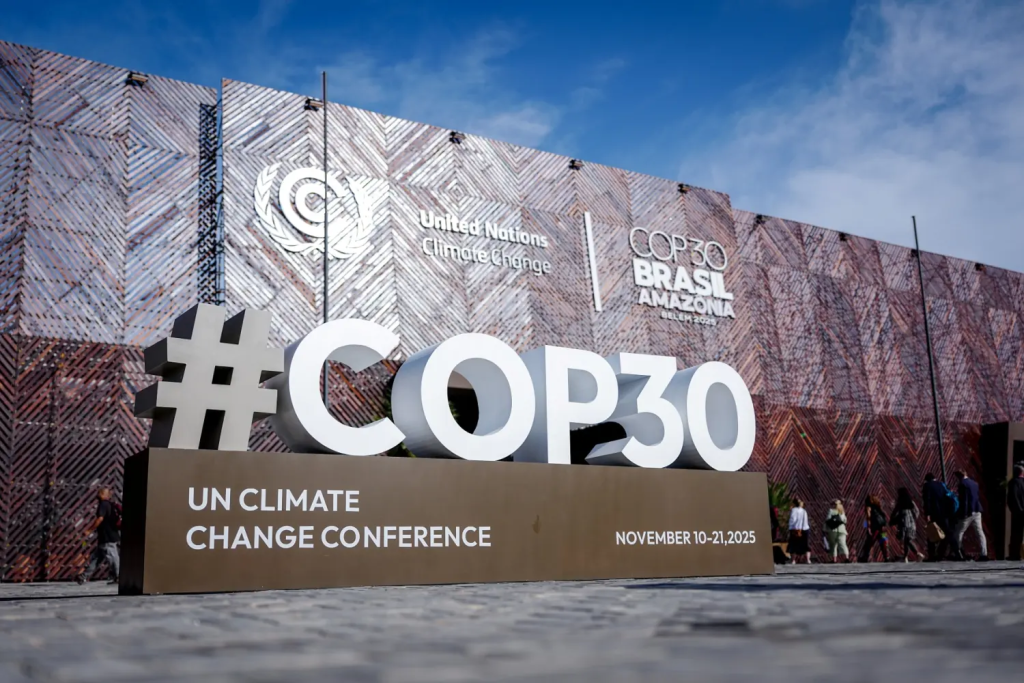
From November 10 to 21 last year, Belem, Brazil hosted the 30th UN Climate Change Conference, formally known as the 30th United Nations Conference of the Parties (COP30). More than 55,000 delegates from member states of the UN Framework Convention on Climate Change (UNFCC) attended, making this the second-largest COP ever held. COP30’s President Andre Corrêa de Lago–who is also Brazil’s current Secretary for Climate, Energy, and Environment–led the conference and the proceedings. Yet despite efforts to make significant agreements on fossil fuel usage, deforestation, and other global issues, the conference concluded in dissatisfaction by many parties, though with signs of progress.
For the first time since the creation of COPs, the United States did not attend COP3 under the direction of President Donald Trump’s administration. Trump has expressed extreme dissent against combating climate change, having coined the movement a “hoax” and a “con job.” In total, 194 out of the 198 UNFCCC member states joined the delegation.
One of the conference’s major shortcomings was its lack of the inclusion of a strive to move away from fossil fuels in an official agreement; extreme dissent from Saudi Arabia, other Arab nations, and Russia, forced this point to be excluded. Despite this setback, COP30’s President Lago offered a compromise, issuing a voluntary plan states could participate in to shift away from burning fossil fuels. Although it takes place outside of the formal UN process, this is still widely accepted as a point of progress in reducing greenhouse gas emissions that contribute to climate change.
The next Conference of the Parties, COP31, will be held in Turkey in the fall of 2026. As the fight to keep global warming under 1.5 degrees Celsius from before pre-industrial times, more effort to suppress the burning of fossil fuels is required. This is not without hope, though–humans can reduce climate change’s impact with thoughtful cooperation between nations from all corners of the globe, a crucial collaboration to prevent disastrous outcomes.
On another note, this conference was a hallmark in indigenous population representation. For the first time, Indigenous peoples had a large say in summit, attending conferences and pushing for action. Major achievements include Columbia’s law forbidding extractivism in the Amazon Rainforest and Brazil’s allocation of land to the Indigenous population.
https://earth.org/did-cop30-succeed-or-fail/
https://www.theguardian.com/environment/2025/nov/25/trump-cop30-lacks-us-climate-progress
https://unfccc.int/sites/default/files/resource/cma2025_L24_adv.pdf