
In recent years, a technology has been developed and invested in, and it could shatter a near-multi-billion-dollar industry: bulkhead and shoreline protection getting replaced by natural solutions and living shorelines. Bulkheads are something that many see possibly daily and don’t think twice, as they are just deemed the norm now and thought to not affect the climate or watershed in any negative way. This is actually far from the truth. Bulkheads cause much destruction to the aquatic life, but also increase erosion in the area, and most importantly, negatively impact water quality. (Prosser, D. J., Jordan, 2018)(Northwest Straits Foundation.2021) What could be the feasible solution, one could ask? That’s when we, the environmental activists, say “Living shorelines and natural bulkheads.” Natural shorelines have always been the go-to solution for water retention from the dawn of time. Not only are they a natural solution, but they are the moral solution. Natural Bulkheads and living shorelines are the more ethical choice, as not only are they hardy plants that absorb wave energy and reduce erosion by having a gradual slope for waves to crash, instead of a large wall that just deflects the energy, but they are also living plants doing photosynthesis and cellular respiration, acting as a filtration system for the water. (Coastal Resiliance Author, 2019) The Plants consume these resources from the water through their sturdy root system, which helps strengthen them, making them stronger and equivalent to artificial bulkheads. In fact, studies show that homes with artificial bulkheads experience more damage than homes with living shorelines, and those same homes were closer to the water than homes with natural shorelines. (Carter S. Smith, 2019) Finally, Natural Bulkeads, through marsh and aquatic plants, complete Photosynthesis and cellular respiration, which consume Carbon Dioxide. With a decrease in CO2 emissions and an increase in CO2 consumption from more marsh bulkheads, CO2 emissions would also go down, minimizing the carbon footprint and the effect on Global warming that an area implementing natural bulkheads would have.
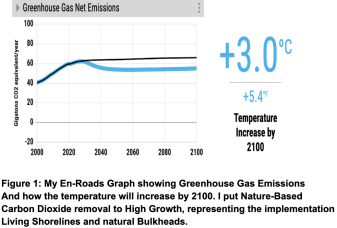
Finally, this explanation relates to the EN-ROADS Prediction graph, because as the Nature-based Carbon Dioxide Removal tab is increased, then greenhouse gas emissions would go down, and therefore, there would be less Global Warming and Climate change affecting the climate if implemented by 2100. Natural Bulkheads would aid in one final aspect regarding temperature increase, the Albedo Effect. When the dark bulkhead surfaces of tar-treated wood or metal are removed with lighter green marsh plants, the solar energy will no longer be absorbed into the water at such high rates, but instead reflected off the lighter marsh and not heat the water as much. This keeps the water’s temperature more consistent, which would in turn keep the air at more consistent temperatures (due to the specific heat rules) and cause a reduction in climate change. (En-Roads climate scenario)
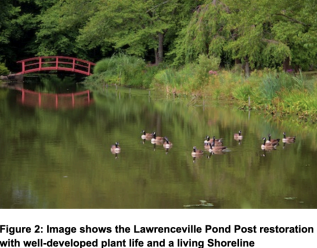
Natural Shoreline solutions are not only relevant in coastal areas like the Jersey Shore, but can be utilized all over the country, and here in Lawrencville is no exception. One of the most valued environmental aspects of the Lawrenceville campus is the large pond South of KMSC. This pond has been a key aspect of the Lawrenceville campus dating back to the 1800s; however, most recently, in 2008, the pond underwent a large restoration, adding some infrastructure like the Bridge and developing the Island that is visible today, but also making sure to maintain the key environmental benefits the pond adds to the ecosystem. (Lawrenceville Archives, 2008) This restoration project included focusing on Natural Shorlines and natural Bulkheads. Instead of surrounding a majority of the Pond with a manmade retention system, a large amount of Natural and aquatic growth was added to ensure strong roots, and therefore strong natural solutions to water retention or natural bulkheads. It’s clear how similar solutions to Natural shorelines and Natural bulkheads are utilized at Lawrenceville as water retention to the pond, but those natural shorelines also provide large benefits to the local climate and ecosystem at Lawrenceville. With the increased vegetation, aquatic and shoreline plant life, not only are the shorelines naturally stronger, but they also sequester more Carbon Dioxide. With denser vegetation along the pond, the plants will sequester
more carbon dioxide, even further reducing the carbon footprint from the Lawrenceville School, reducing local Climate change. The installation of natural shorelines around the Lawrenceville Pond will allow future Lawrencians to enjoy the pond for many years to come.
Finally, Although Natural shorelines and Bulkheads have so many benefits, not only in minimizing climate change and warming weather but also in supporting the environment and actively moving shorelines, there are still many arguments for using artificial bulkheads. Although Natural Bulkheads are generally the cheaper option for water retention compared to artificial bulkheads, considering living shorelines never need to be replaced and require minimal maintenance compared to artificial bulkheads, there are still negative views from waterfront homeowners. They feel it would impact and cause more regulations and ordinances on their property, would not be as effective with storm retention, and would minimize the freedoms they can have with their land, especially with docks and how people can access the water from their property. (Ship Bottom Project Board: Barbara Woolley-Dillon, 2024)
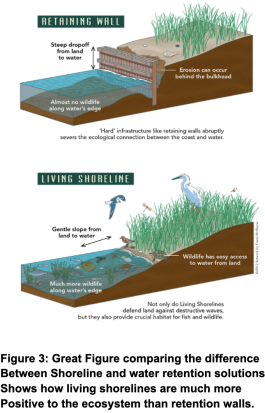
Although these arguments seem understandable, when thinking about the argument, the negative views of the Natural Bulkheads get largely outweighed by the many positive impacts. Aside from the previously stated reduction of CO2 in the environment and helping to cool and filter water minimilizig the amount of chemical and nutrient leaking in the water, Natural Bulkheads have a third very important role in the environment, ensuring protected wildlife have safe and ample ecosystems to live and thrive in. (Graffam, Molly, 2020) On Long Beach Island, NJ, the increasing population and growing development of waterfront land by large developers, installing large bulkheads, has also brought a decrease in the vulnerable NJ Terrapin turtle, which can no longer access the shoreline habitat where they live. (Save Coastal Wildlife Author, 2025) Ethically, these developers, driven by the Economic ethic, are utilizing the land for pure economic gain, disregarding the lives of the animals living there before. If LBI made the switch to full natural shorelines and bulkheads, however, these turtles, along with many other animals, would be able to access their habitats, and an increase in population would follow. Therefore, Natural bulkheads would be a perfect Balance of Leopold’s ethic, still allowing for humans to use their lands and access the water, but also respecting the native creatures and allowing for their living habits to thrive as well.
Bibliography
Save diamondback terrapins in New Jersey. Save Coastal Wildlife. (n.d.). https://www.savecoastalwildlife.org/save-diamondback-terrapins#:~:text=Unfortunately%2C%20n early%20all%20terrapins%20that,homes%20from%20sea%20level%20rise. 2025.
Weinkle, J. (2021, April 30). Transitioning away from bulkheads. Transitioning Away from Bulkheads. https://thehaintblue.blogspot.com/2021/04/transitioning-away-from-bulkheads.html
Prosser, D. J., Jordan, T. E., Nagel, J. L., Seitz, R. D., Weller, D. E., & Whigham, D. F. (2018). Impacts of Coastal Land Use and Shoreline Armoring on Estuarine Ecosystems: an Introduction to a Special Issue. Estuaries and Coasts, 41, S2–S18. http://www.jstor.org/stable/44858178
Smith, C. s. (2019, November). Past hurricane damage and flood zone outweigh shoreline hardening for predicting residential-scale impacts of Hurricane Matthew. Shibboleth authentication request. https://www-sciencedirect-com.bunnlibrary.idm.oclc.org/science/article/pii/S1462901119304204
Graffam, Molly (2020, August 1). Hydro-biogeochemical processes and nitrogen removal potential of a tidally influenced permeable reactive barrier behind a perforated marine bulkhead. https://www.sciencedirect.com/science/article/pii/S0925857420302214
Barbara Woolley-Dillon. Shipbottom- Resilient Long Beach Island. (n.d.). 2024. https://shipbottom.org/wp-content/uploads/2024/08/2024-08-22-Ship-Bottom-Meeting-full. pdf Northwest Straits Foundation. (n.d.). Shore Friendly Living – Managing Shoreline Erosion: Bulkheads or Natural Solutions. YouTube. https://www.youtube.com/watch?v=wZAmPBAd_KI&t=23s
Coastal Resiliance New Jersey. Planning Living Shoreline Projects. 2019. https://coastalresilience.org/wp-content/uploads/2019/09/Community-Resource-Guide-Fi nal-Released-2019_High-Res.pdf#:~:text=Nature%2DBased%20Living%20Shoreline%2 0Nature%2Dbased%20living%20shorelines%20are,nature%2Dbased%20living%20shor elines%20with%20living%20reef%20breakwaters.
Roads climate scenario. En. (n.d.). https://en-roads.climateinteractive.org/scenario.html?v=26.2.0&p1=14&p7=8&p10=0.6&p417=100