
In today’s world, I believe that electric buses are a great climate solution because they are replacing standard-issue gas-powered buses, which release harmful pollutants into the air, which affects greenhouse gas emissions and local air pollution.
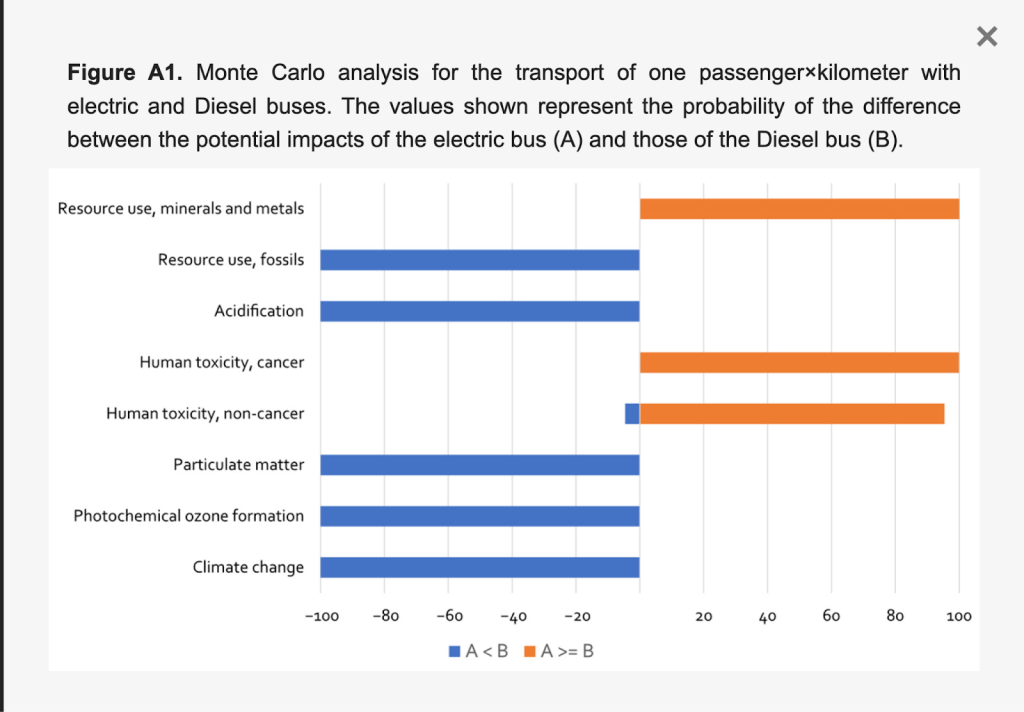
When digging through peer-reviewed research that was conducted about the benefits of switching to electric-powered school buses, it showed that greenhouse gas emissions would decrease significantly, with an estimated “33–65% within the next 14 years, depending on how quickly the transition is made and how quickly the electricity grid decarbonizes.” (Martinez & Samares, 2024). The “Monte Carlo” analysis, a risk-assessment technique created by Stanislaw Ulam, that uses many random simulations to predict the outcomes of certain things (Kenton,2025). When using the Monte Carlo analysis, the study found that “For instance, regarding the climate change indicator, the probability that the value calculated for the electric bus is lower than that for the Diesel bus is 100%,” which demonstrates how the buses are very likely to be better for the environment. (Martinez & Samares, 2024) It is also seen in the graph above. (Martinez & Samares, 2024) However, in this article, the authors both discuss the negative tradeoffs that come with switching to an electric bus fleet by saying “It is worth noting that the use of HVO (Hydrogenated Vegetable Oil) almost doubles the impact on resource use, minerals and metals, and significantly increases all other impact categories, except for climate change and resource use, energy.”(Brambilla & Girardi,2025) The final research article that I found on the internet, it talked about how the air pollutants that came from the school buses were harmful to the children on the buses. The article said that “Diesel exhaust exposure is harmful to human health, and has been correlated with adverse cardiovascular outcomes, and adverse effects on reproduction, development, and the central nervous system,” and how the diesel exhaust exposure caused “nearly 9 million deaths across the globe” in 2015.(Both Bursey & Kalisa, 2025) Making the switch to electric school buses, it reduces the children’s exposure to the toxic chemicals that the buses release.
In the United States today, we are seeing the rapid switch from gas-powered buses to electric. In New Jersey, the New Jersey Transit is began to make the switch in 2020 when they rolled out their Energy Master Plan. One of the key points was the decarbonization of the transportation sector through electrification. The New Jersey Transit is paving their way to making sure there is less pollutants in the area by forcing all “purchases made on or after December 2024 must include at least 10% zero-emission buses, escalating to 50% by December 2026, and 100% by December 2032” and prioritizing the distribution of these buses to “low-income, urban, or environmental justice communities.”(Both NJ Transit, 2020) Similarly, King County in Washington just began to make the switch to electric buses just under a month ago. In King County, former executive Girmay Zahilay said they were doing this in their communities because “many experience higher-than-average levels of traffic-related air pollution,” and they need a way to fix it. Zahilay believes that “deploying zero-emission buses in these neighborhoods supports healthier air quality while expanding access to cleaner transit options.” (Both Sanders, 2026) People across the United States are seeing the negative effects that using the gas fueled buses has on the environment around us and are beginning to make the transition to using electric-powered buses.
We as a school need to make the change to using electric-powered school buses. We prioritize reducing greenhouse gas emissions by having one of the largest solar panel farms in the country, but we still use gas-powered buses when we go to away games or travel to school trips. I believe that we need to start renting buses from electric bus companies rather than renting from gas-powered companies when we have school trips, or teams have away games, because if we rent from the electric bus companies, we will reduce our greenhouse gas emissions and have an overall positive effect on the environment around us, which is a key pillar to our school’s environmental plan. However, we will need to spend a lot more money in order to install chargers for these buses, and the chargers that we use will be pulling energy from the earth and will release gas into the air.
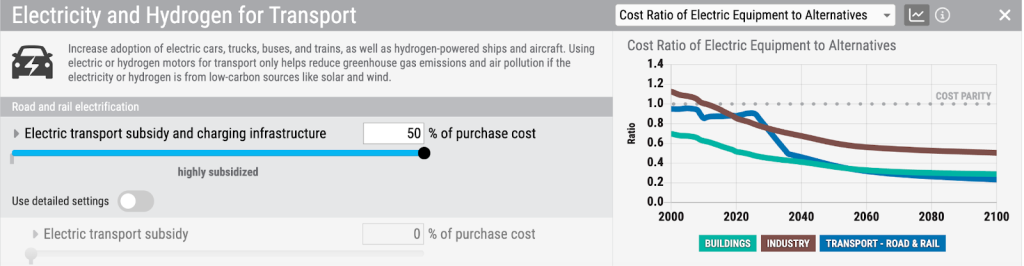
In my EnRoads graph, I changed the electric transport subsidy and charging infrastructure from 0% of the purchase cost to the max which represents strong support across the world for electric buses and other electric vehicles. When comparing the base graph to the final, you can see that with the higher subsidy, the cost of electric transport drops faster and becomes a lot cheaper than fossil fuel sooner, which would cause the adoption of electric vehicles worldwide. In the 50% graph, you can see that the transport line drops a lot more steeply and reaches below cost parity earlier, meaning that electric buses become cheaper sooner.
In the 0% graph, the cost still declines over time, but a lot more slowly, and electric transport remains closer to fossil fuels for longer.
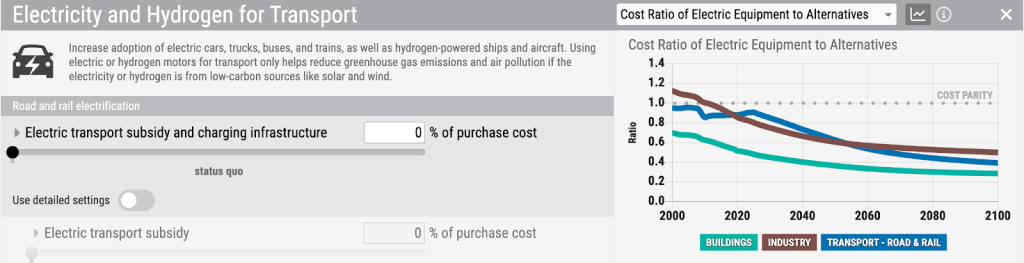
This makes it seem that stronger subsidies accelerate cost reductions and are more likely speed up the adoption of electric vehicles.
Through peer-reviewed sources, recent news articles, and my Enroads graph, it is evident that making the switch to Electric School Buses would benefit not just the environment but the school as well. The one downside to using electric school buses is that the battery materials that would be used for the buses and the electric charging stations would still require energy somehow, and it would also cost a lot of money to do this
Works Cited
Hawkins, T. R., Mansell, R. S., Jaramillo, P., & Azevedo, I. L. (2025). Electrification of transit buses in the United States reduces greenhouse gas emissions and air pollutants. Environmental Science & Technology. https://doi.org/10.1021/acs.est.2c07296
Brambilla, P., Girardi, P. (2025). Comparative life cycle assessment of electric and diesel buses. Sustainability, 17(21), 9786. https://www.mdpi.com/2071-1050/17/21/9786
Bursley, V., Kalisa, A. (2025). Health and environmental impacts of electric school buses. Science of the Total Environment. https://www.sciencedirect.com/science/article/pii/S0048969725014846
NJ TRANSIT. Zero-Emission Buses. https://www.njtransit.com/zero-emission-buses
Summit Daily News. (2025, May 10). Summit School District secures four new electric buses, fully funded by grants. https://www.summitdaily.com/news/summit-school-district-secures-four-new-electric-buses-fully-funded-by-grants/
King County Metro. (2026, January 29). King County launches new battery-electric buses with enhanced operator safety features. https://kingcountymetro.blog/2026/01/29/king-county-launches-new-battery-electric-buses-with-enhanced-operator-safety-features/