
In today’s world, when people talk about bettering water quality and helping the environment, they substantially regard artifacts such as Green Infrastructure, Natural Filters, and Modern Wastewater Treatment Plants; but one thing that is thoroughly undermined and should be paid more attention to is the benefits of Floating Solar Panels. Being established in 2007, Floating Solar panels are convenient for bettering the environment by producing clean water, saving money, and protecting water quality. Unlike regular solar panels that take up land, they are manufactured to sit on top of lakes, reservoirs, and water-drinking treatment ponds. Not only do they help with water quality, but they also use renewable electricity that reduces greenhouse gases and the cost of money. This innovation is very versatile as it also helps arid countries, such as places like Jordan. Al-Widyan, Khasaweneh & Abu-Dalo (2021) researched how beneficial floating panels were in Jordan, measuring the difference in energy, water evaporation, and water quality between normal-land panels and floating panels. They found that floating solar panels generated 5% more electricity and hindered the evaporation of water, having a 30% water coverage, saving about 31% of water in one month (2021). This is extremely important for dry places like Jordan, as less evaporation means more water is saved. The floating panels also made the water clearer and decreased the algae growth, which limits the bacteria that pollute the water. This is because the floating panels block the sun from causing the algae to grow. These results are significant because they display the savings of water and energy for places that cannot afford these expenses. Testing its true versatility, another test was done by scientist Qasem Abdelal on an irrigation pond by a farm. He wanted to see the impact of the floating panels by comparing the differences between a pond with solar panels on top of it and another pond that was uncovered, measuring the difference in water quality and how much water was evaporated. The results showed that the floating panels did not harm the water but rather improved the quality as it increased nitrate levels and decreased chlorophyll levels, meaning less algae growth. Due to the panels providing shade, they also decreased the water evaporation by 60% compared to the pond that was uncovered. To prove floating solar panels’ true consistency, another test was done by the U.S. Bureau of Reclamation(2011). They created a document that provides information about how SPG solar floatovoltaics enables customers with no available land or roof space to enjoy the benefits of solar while capitalizing on typically non‐revenue generating area—water. The array cuts evaporation losses up to 70% of the water(2011). The document also notes that reducing direct sun exposure can improve water quality by reducing water temperature, which can help with issues like algal growth and thermal stress(2011). They also emphasize that the plastic floats are approved for use in drinking water reservoirs (NSF-approved resin, U.S. Army Corps approval), so they are compatible with potable water quality requirements (2011).
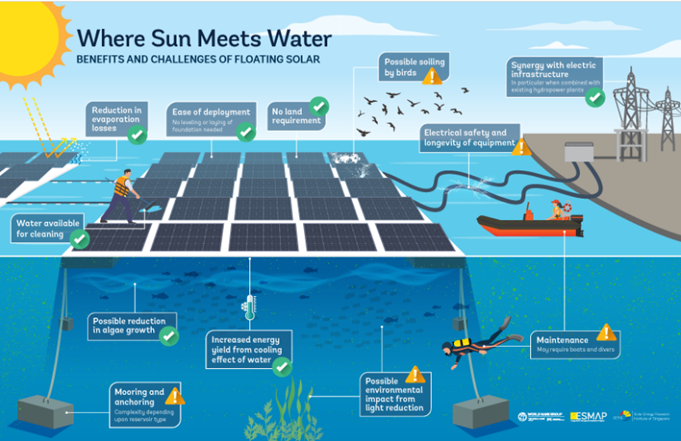
Figure 1: (The picture represents the benefits and challenges of having floating solar panels, such as benefits like reduction of water evaporation, no land requirement, increased energy yield from the cooling effect of water, etc. But also has challenges like possible environmental impact from light reduction, mooring and anchoring, and electrical safety.)
Although floating solar panels have a variety of benefits for the environment, they can also pose certain difficulties, mainly focusing on the affect of aquatic life. Scientists Sandrini, Wagenvoort, Asperen, Hofs, Mathijssen, and Wal(2025) wanted to study to see what would happen if a floating solar panel were placed on top of shallow water. They placed floating panels on top of a shallow drinking water reservoir having the panels cover 24% of the water surface. After examining what the solar panels did, they noticed that there was an increase in “benthic cyanobacteria” (a type of blue-green algae that grows on the bottom of the solar panels)(2025). The algae negatively affect the water, harming the water quality, production of toxins, and causing trouble for clean drinking water. Not only did these types of issues spawn, but natural entities such as macrophytes and stonewort algae (Chara) that are present, and signs of clear water, disappeared due to the toxic algae. The panels blocking the sun were also a huge factor. Since the water drinking reservoir is small and shallow, the panels blocking the sun actually make bacterial algae grow, along with the suppression of sunlight that the plants get, they are unable to perform photosynthesis, which prevents the flow of oxygen that the aquatic life breathe in the water in order to live. The panels blocking the sun for bigger lakes, ponds, reservoirs, etc., are beneficial but not for smaller shallow ones, provided that FSP should only be used for bigger water entities. As there has been a focus on money on how FSP can improve the water quality and lessen the water evaporation, but another immense benefit they bestow is their use of renewable energy. FSP’s use of solar energy is so important because there are no fossil fuels used to generate its energy, which can create carbon emissions and pollute the air. Not only does their renewable energy usage prevent air pollution, it also helps the social impact with saving money as the Ellis Creek Floating Solar Project in California states, “By producing on-site renewable energy, the Ellis Creek Water Recycling Facility (ECWRF) will also reduce its reliance on grid electricity, saving taxpayer dollars on long-term operations. The anticipated savings are nearly $500,000 per year – or roughly $11 million over the system’s 20-year lifespan”(2025). Not only does renewable energy help with saving money, but the amount of voltage power that the FSPs obtain is sincerely sbutstantial. An article by OSU, created by Roman Battaglia, focused on the energy potential of the FSPs and conveyed the statistic that if “floating solar panels were installed on all federally controlled reservoirs in the U.S., they could generate enough electricity to power about 100 million homes”(2025), which illustrates the large‑scale energy potential of the technology. These FSPs, acting as arrays, also help cold-water aquatic life. When the arrays reflect the energy away from the water, the water cools, making it easier for cold-water aquatic life to live in.
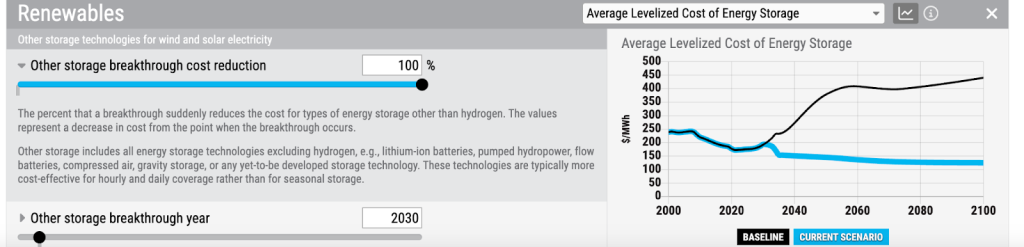
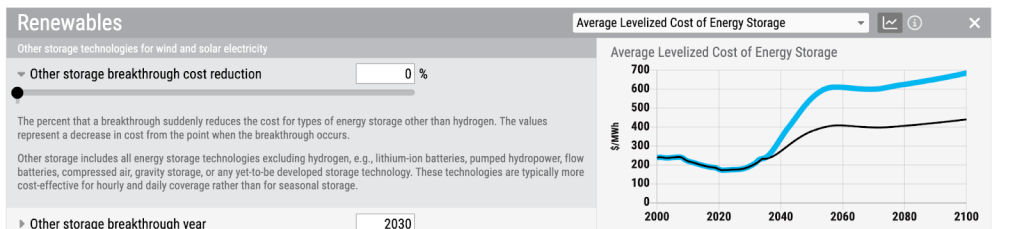
(The two figures above show the difference in Average Levelized Cost of Energy Storage, depending on the percentage of storage breakthrough cost reduction, which is essentially the idea that a new technology has been created that also makes other storage. They both have a blue line which is the cost in the current scenario of the cost reduction you have chosen, and the black line is the baseline future if no special changes were made with the y-axis being the average price to store 1 unit of electricity and x-axis being the number of years. As you can see in figure one, when the cost reduction is high, the cost of energy storage decreases. This is what we want because the cost of cheaper storage for renewables makes it easier to store solar and wind power if there is any extra. It also supports the prevention of using fossil fuels that pollute the air. Lower $/MWh means lower electricity prices, which makes renewable energy systems more attractive and draws people away from having fossil fuels as their backups. Figure two is, on the contrary. If there is no cost reduction and no new technology being made, the $/MWh is a lot higher, which will only draw companies and corporations towards using fossil fuels, as they are fairly cheap despite their detrimental effects on the environment. Although the high cost percentage reduction shows the possible benefits of the environment, it is still difficult to draw people away from fossil fuels, as they are cheap and are a familiar tool to use. I believe a way to cease companies’ attraction is to tax fossil fuels. Despite their efficiency, fossil fuels are doing a disservice to our environment by creating greenhouse gases and polluting the air that we breathe all around the world. Taxing fossil fuels will not only terminate their destruction due to their high costs, but will also draw people towards renewable energy source systems such as FSPs, which then will commence a chain of benefits to the environment as they improve the environment, save us money, and protect water quality).
Although Lawrenceville has shown true seriousness and success in its sustainability through its existing land solar panels, I believe the innovation of FSPs would give Lawrenceville that much more of an advantage when it comes to improving our ecological success. I say this because the advantages of FSPs are clear, with a variety like the preservation of campus land that could possibly be used for things like outdoor learning, more athletic fields, or even ecological restoration. This would also enlarge their renewable energy production which saves the school money. Our water source would be a lot better due to the decreasing of water evaporation and the escalation of more water.
FSPs constitute a big stepfoward in the workings of protecting our environment and improving our water quality. With its artifacts such as unused water surfaces, preserving valuable land, reduction of evaporation, and generating of more electricity, FSPs display a very high benefit but little to no cost for a solution to better our environment. These antiques will ensure a bright future in protecting the environment as the stock of FSPs gradually increases through the years.
Citations:
Abdelal, Q. (2021). Floating PV: An assessment of water quality and evaporation reduction in semi-arid regions. International Journal of Low-Carbon Technologies, 16(3), 732–739. https://doi.org/10.1093/ijlct/ctab001
Cazzaniga, R., Cicu, M., Rosa-Clot, M., Rosa-Clot, P., Tina, G. M., & Ventura, C. (2021). Floating photovoltaic plants: Performance analysis and design solutions. Energies, 14(24), 8417. https://doi.org/10.3390/en14248417
Liu, H., Wang, X., Lin, H., Li, H., & Zheng, B. (2023). Environmental impacts and optimization of floating photovoltaic power plants on water bodies. Water, 17(8), 1178. https://doi.org/10.3390/w17081178
U.S. Bureau of Reclamation. (2012). Evaporation reduction via floatovoltaics systems (Colorado River Basin Water Supply and Demand Study). U.S. Department of the Interior. https://www.usbr.gov/lc/region/programs/crbstudy/1_Evaporation_Reduction_via_Floatovoltaics_Systems.pdf
City of Petaluma. (2020). Ellis Creek floating solar project. https://cityofpetaluma.org/ellis-creek-floating-solar-project/
Oregon State University. (2025, November 28). Floating solar could power millions, but with ecological trade-offs [Radio broadcast]. Jefferson Public Radio. https://www.ijpr.org/science-technology/2025-11-28/osu-study-floating-solar-could-power-millions-but-with-ecological-trade-offs