
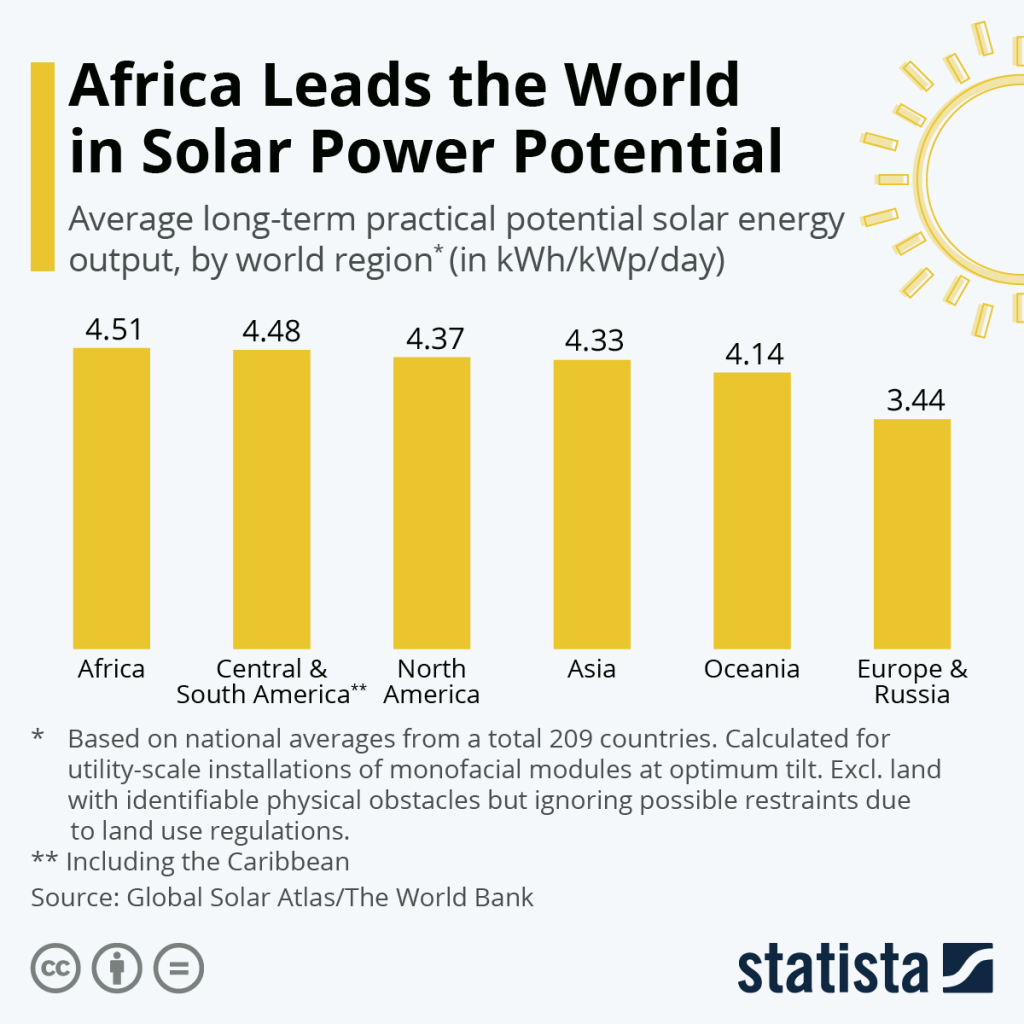
As the world entered the 21st century, environmental awareness increased and the cost of solar panels decreased. Many countries developed an interest in solar energy, including China, India, and the United States’ whose solar demand rose significantly. However, in the near future, the greatest solar potential is predicted to be in the African continent.
Africa’s economy is lacking reliable electricity, and fossil fuels simply aren’t cutting it. Solar power’s affordability is helping cut costs for households and small businesses; it is also proving more reliable than big utilities. In 2024, 91% of new renewable power projects were more cost-effective than new fossil fuel alternatives globally. In addition, frequent blackouts and costly grid power are pushing many countries, chiefly South Africa and Egypt, to turn to solar power instead of commonly-used diesel generators.
Africa’s economy relies heavily on agriculture. In recent decades, agricultural development has decreased significantly in Africa, leading to struggling economies. Concomitant problems of energy reliability and affordability have led to a “bottom-up” movement with households and small businesses adopting solar power. Solar is powering irrigation, cooling residences, and increasing crop yields across the board. It is no coincidence that solar capacity in Africa is also on the rise.
In less than three years, Africa’s solar market is expected to double its current capacity of solar power. China’s mass production of solar panels has dropped costs significantly, making solar power a more appealing choice for developing African countries. Still, fossil fuels dominate (77%) Africa’s energy usage with renewables only contributing a small share. Despite the political instability many countries in Africa face, some leaders, like Libya’s Government of National Unity and Ethiopia’s Prime Minister, have committed to significantly scaling renewable capacity.
In addition, adopting renewable energy has major health benefits. A decrease in air pollution caused by fossil fuels will help tackle the reduced life expectancy in some countries. Clean energy will boost health outcomes through the people’s livelihoods and income, indirectly improving nutrition and medical care options.
Still, many challenges remain, including financing costs and policy barriers which limit large-scale investments in solar energy. Nigeria, South Africa, and other large nations whose state-owned utilities are often bankrupt are seen as less ideal choices for long-term solar power contracts. Infrastructure barriers still exist for large scale and corporate solar development. Despite the “bottom-up” movement’s success, it might be decades before larger companies see the value of solar economies of scale. However, Africa’s growing solar demand is predicted to become a powerhouse of renewable energy. Studies even suggest that over 70% of Africa’s energy will be sourced from renewables by 2040 through solar and hydropower, authenticating the growing solar demand.
Sources:
https://earth.org/africa-will-be-next-center-for-solar-demand-say-industry-leaders/
https://www.nytimes.com/2025/12/30/climate/solar-south-africa-
china.htmlhttps://africaclimateinsights.org/africas-push-and-progress-in-renewable-energy-scale-up/