
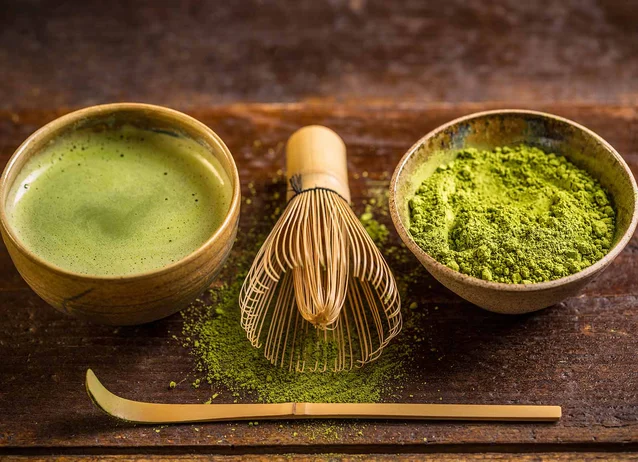
Today, matcha can be seen all over the world from food bloggers and influencers all the way to your fellow Lawrentian’s cup. While the new performative trend has exploded the popularity of matcha within the past few months, trends from the past few years already showed the increase in worldwide demand. Despite increasing exports helping to develop the Japanese economy, the demand has highlighted sustainability concerns and hindered local accessibility to matcha. With matcha’s growing popularity, consumers must also understand its sustainability concerns. .
For the past few years, international matcha exports have been growing exponentially. In 2025 alone, the Japanese Ministry of Agriculture released a report showing that exports have gone up by 16% in volume and increased 25% in value. Furthermore, the total demand for matcha has far surpassed Japan’s 15,000 ton target set for 2030. In Kyoto, Japan’s largest city for growing tea leaves, the value of leaves has increased by 170%, or around $55.35 per kg. As matcha production grows in response to the international market, it is necessary to identify the possible harmful effects of over-consumption.
The growing demand of matcha has already incentivized tea farmers to increase their farm sizes; though ideally, farmers want to keep up with demand, scaling up presents multiple negative side effects. Soil exhaustion and a lack of biodiversity both are currently fears of the expansion of tea farms. To keep tea and matcha sustainable, Japanese farmers use organic fertilizers, crop rotation, and advanced irrigation systems to reduce water waste. Furthermore, most tea-leaf farms that help produce matcha are small-family run farms and local businesses. New solar-powered grinding mills are being developed as well to reduce the amount of energy used to produce the final green powder. Current systems in matcha development already bolster sustainable practices; as production increases, innovations and observation are necessary to continue healthy environmental practices.
As producers of matcha find ways to follow sustainable practices, it is time for the consumer to understand how to enjoy matcha sustainably. Though the tiny packaging of matcha may seem the most wasteful part of a purchase, the shipment of matcha actually results in the most carbon emissions and acceleration to global warming. Most matcha products ship through airfreight resulting in high carbon emissions; in an effort to be more sustainable, consumers should not only purchase matcha with sustainable packaging but also attempt to utilize sea freight and local stockists to reduce their carbon footprint.Similar to how farmers are aiming for sustainable practices, matcha enjoyers must also put in the same effort to keep matcha an environmentally friendly product.
The fad of matcha likely won’t disappear for the next few years; Japanese tea farmers will need to deal with overconsumption and meet the demand for produce without sacrificing sustainable practices. If you or your friends want to enjoy a matcha latte, cookie, boba tea, etc., for you to stay sustainable, it is not only important to find environmentally-friendly packaging and shipments but also to support small Japanese businesses that prioritize sustainability.
Sources
https://sustainabilitymag.com/news/how-high-temperatures-have-caused-mass-matcha-supply-issues