
As the effects of climate change have become more and more apparent, scientists around the world have also realized that carbon emissions play a significant role in the changing of earth’s climate. This is due to the fact that “Carbon dioxide, and other greenhouse gases, absorb infrared energy and re-emit it in all directions, warming the earth’s surface and lower atmosphere”(Nasa Author 2026). Given the fact that carbon emissions have a direct relationship with temperature, scientists and climate activists have been searching high and low for the best ways to reduce carbon emissions. One of the most common tools used to reduce CO2 emissions is trees, because trees sequester high amounts of CO2 from the atmosphere during the process of photosynthesis. Another method for reducing CO2 emissions is by switching the type of energy used, through solar panels, wind energy, ect,. However, one new, unknown, and exciting method of CO2 reduction is Carbon Capture Technology. In this article, I will explain CO2 capture technology, put forward the benefits and tradeoffs of this technology, and connect it to our community.
According to the International Energy Agency, Carbon Capture technology is “a suite of technologies that can capture CO2 from fuel combustion or industrial processes, transport it via ship or pipeline, and either use it as a recourse or store it permanently underground”(IEA Author 2026) This is a very interesting method of CO2 sequestration for two reasons: One, it uses technology instead of natural processes, and two, it literally absorbs and stores this CO2 underground and transports it somewhere. Carbon capture technologies tend to fall under 3 main strategies: pre-combustion, post-combustion, and oxyfuel combustion. In oxyfuel combustion, “pure oxygen is used in combustion to produce flue gas with high purity of CO2. In the pre-combustion CO2 capture process, fuels are partially oxidized by steam or oxygen to produce synthetic gas, followed by water gas shift reaction to form hydrogen-enriched gas.” (Fu 2024) Essentially, these two categories separate the carbon before it reaches the air, one being before fuel is burned while the other separates during combustion, which creates a stream of CO2 that is easy to capture. In the final category called post combustion, CO2 is captured after the combustion, essentially separating the carbon from the flue gas, and then sequestering it for storage.
(Figure Description: This diagram represents the three methods used in carbon capture technology, showing the differences of the processes relative to pre-combustion, post-combustion, and oxyfuel combustion) (Goic 2016)
Carbon capture technology has both benefits and drawbacks. The main benefit of CCT is the “possibility that it can decarbonize existing power and industrial infrastructure,” (DOE Author 2022) and reach “hard-to-abate sectors such as cement,steel, [and] chemicals” (DOE Author 2022). Essentially, Carbon Capture tech can radically change the levels of CO2 emissions from industries and common people, and also remove carbon from places that natural carbon sequestration methods can’t. Another benefit of carbon capture is the feasibility of the materials needed to construct and use CCTs. Carbon capture technology “is not constrained by fundamental raw material scarcity”,(DOE Author 2022) meaning that this technology does not depend on rare materials and instead mostly uses steel, concrete, pipelines, and other common tools. Therefore, it is easier to create and operate carbon capture technologies because the materials needed to create CCT are easy to find and utilize. As a result of the feasibility of the materials, “Most CCS equipment can be manufactured domestically,”(DOE Author 2022) leading to minimal trade costs when creating CCT. However, CCT also carries some disadvantages. This includes the fact that CCT requires a lot of energy input to operate, evidenced by the fact that “ operating CCS equipment requires a power plant to increase its electricity production by approximately one-sixth to nearly one-third more than it would produce without CCS” (C.C.A 2026), meaning that in order for this technology to sequester emissions, it would have to produce some emissions as well. Another downside of CCTs is the fact that even though CCT can reduce some prices, it is still very costly with “Cost estimates for carbon capture and storage range between $15 and $130 per metric ton of CO₂” (C.C.A 2026), with certain technologies such as direct air capture costing “ from $100 to over $300 per ton,”(C.C.A 2026),. While $15 per ton might not seem like a lot, the amount of carbon in the atmosphere is so high that $15 per ton will still end up costing a large sum. These benefits and drawbacks present a question that is impossible to answer; Is carbon capture technology effective enough that eventually its benefits will outweigh its costs?
In order to analyze our communities’ use of CCT, it is important to look at both the actions of New Jersey, and the actions of Lawrenceville itself. New Jersey has slowly begun to experiment with carbon capture technology. This has been done through the New Jersey Natural Gas, the principal subsidiary of New Jersey Resources. They have done this by experimenting with CCT in their office buildings; “These units, the first of their kind in operation in New Jersey, connect to the company’s heating, ventilation and air conditioning system, where they capture carbon emissions from the building that otherwise would be emitted as flue exhaust” (NJNC Author 2025). Joe Norris, CEO of Carbon Reform, the company used to create these CCTs used in these buildings, said “Our work with New Jersey Natural Gas demonstrates how utilities can play a crucial role in bringing sustainable technologies directly to communities,” (Author, N. 2025) and “Together, we’re showing that carbon-reduction technology can deliver other efficiencies, supporting more cost-effective building operations in a pragmatic way”, (Author, N. 2025). These implementations of CCTs seem to have been effective, but infrequent, which is evidenced through Lawrenceville itself and its lack of Carbon Capture Technologies. According to Lawrenceville’s decarbonization plan, the main source of decarbonization is the Big Red Farm. Specifically, the solar panels create a separate form of energy that does not burn fossil fuels, and the trees, both on the BRF and throughout campus, sequester carbon (LDP report 2024). Lawrenceville does not use any Carbon Capture Technologies, possibly due to the uncertainty of the technologies’ success and the high cost of the CCT. In order for CCT to become more popularized, someone/group needs to take the risk and implement these technologies, which might prove to heavily reduce carbon and reduce climate change, but could also prove to be not worth the high price and be quickly disregarded.
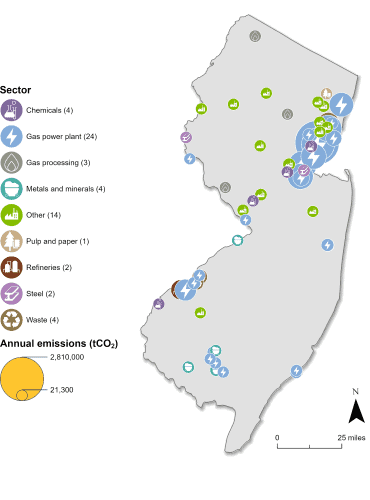
(GPI 2026)
(This map shows how various regions contribute to net CO2 emissions, which illustrates New Jersey’s need to find a good solution for carbon sequestration)
The Enroads simulator can be very representative of the effects of increased Carbon Capture Technology. Specifically, the simulator can be used to show the benefits of the government subsidizing CCTs. Looking at the Cost of Direct Air Carbon Capture Storage graph, as subsidies on Direct Air Carbon Capture increase, the cost of Direct Air Carbon Capture technologies starkly decreases. This shows that these expensive CCTs can be more accessible if the government gives subsidies for these technologies, and the main factor that hinders the use of these effective technologies is the price, so government subsidies on CCTs could reduce climate change and CO2 emissions immensely.
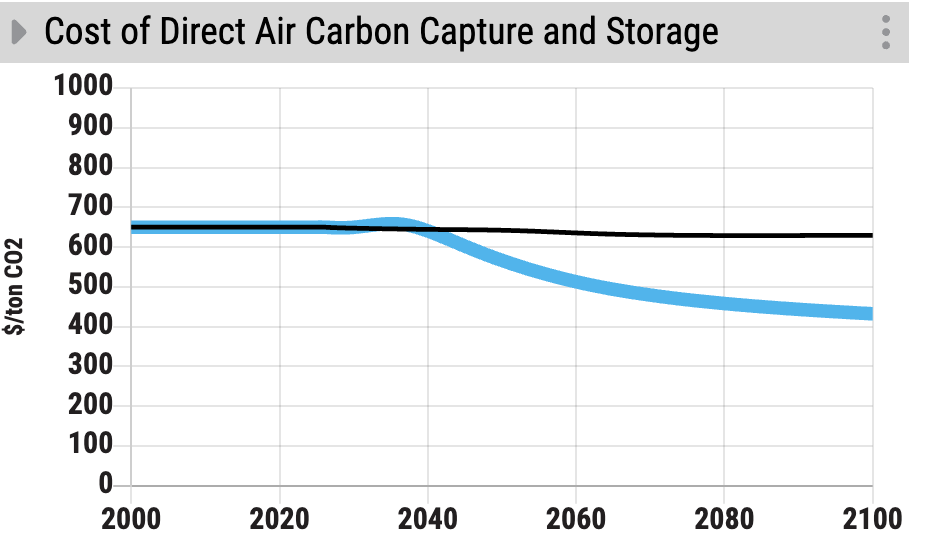
(This graph shows how an increase in CCT subsidies will result in cheaper CCT prices)
Goic, R. (2026, February 26). Path of carbon dioxide capture technologies: An overview. ScienceDirect. (image one)